
To yield farm crypto is to put your digital assets to work, earning you more crypto in return. Instead of letting your coins just sit idle in a wallet, you're actively using them within the world of decentralised finance (DeFi) to generate a steady stream of rewards.
It’s basically a way to earn a kind of passive income, much like getting interest from a traditional savings account, but with its own unique rules and often much higher potential returns.
What Is Crypto Yield Farming and How Does It Work?
At its heart, yield farming is the process of lending out your cryptocurrency through DeFi platforms. You’re not just holding onto an asset hoping its price goes up (a strategy famously known as “HODLing”); you're making that asset productive.
This process is what keeps the DeFi ecosystem humming. By locking up your funds, you provide the essential fuel—known as liquidity—that allows these platforms to operate. In exchange for this service, the platform rewards you. These rewards usually come in the form of more crypto, which you can then put back in to generate even more returns. It’s a powerful cycle.
The Core Goal of Yield Farming
Simply put, the main goal is to make your crypto generate more crypto. For many, it's a change from being a passive investor to an active participant. You're no longer just betting on price changes; you're using your assets to create a consistent yield.
The potential returns are often shown as an Annual Percentage Yield (APY), a number that can sometimes make the interest rates from traditional banks look tiny. This potential is getting a lot of attention, especially as the crypto market becomes more established. The UK's cryptocurrency market, for instance, hit a value of USD 301.2 billion in 2024 and is predicted to reach USD 550.9 billion by 2033. This growth, tracked on imarcgroup.com, shows a wider acceptance of digital assets and the strategies behind them.
Before we go deeper, let’s break down the main parts with a quick summary table.
Yield Farming at a Glance
This table simplifies the key ideas we'll be exploring, giving you a clear picture to work with.
| Component | Simple Analogy | Purpose in DeFi |
|---|---|---|
| Liquidity Provider (You) | A person putting money into a bank's savings pool. | You supply the crypto assets needed for trading and lending. |
| Liquidity Pool | The bank's combined savings pool from all depositors. | A smart contract holding funds that enable decentralised trading. |
| Yield (Rewards) | The interest you earn from the bank for your deposit. | The fees or new tokens you earn for providing your assets. |
Understanding these three pieces is the first step. You provide the assets, they go into a shared pool, and you get rewarded for your contribution.
The Analogy of a Digital Farmer
A great way to think about this is to picture yourself as a high-tech farmer. Instead of dealing with soil and seeds, you're working with protocols and tokens.
- Your Seeds: These are your crypto assets, like Ethereum (ETH) or a stablecoin such as USDC. For example, you might have £500 worth of ETH ready to invest.
- Your Farmland: These are the different DeFi platforms you can "plant" your seeds in. Popular ones include Aave, Uniswap, or Curve.
- Your Harvest: This is the yield you generate. For instance, you could earn interest paid in ETH, or you might get brand-new tokens from the platform itself, like earning UNI tokens on Uniswap.
Just like a farmer might switch crops between different fields to get the best results, a smart yield farmer often moves their crypto between different platforms to chase the highest returns. This strategy is even known as "crop rotation" in the DeFi community.
A key takeaway is that yield farming turns passive asset holders into active players in the DeFi economy. By providing liquidity, you are not just an investor; you are a vital part of the system that allows decentralised exchanges and lending platforms to run smoothly.
This hands-on approach definitely needs more knowledge and active management than just buying and holding. You'll need to get comfortable with how these platforms work and the risks they carry. For a closer look at the basic mechanics, you can start with our beginner's guide to liquidity pools. In the next section, we’ll break down the specific parts that make it all possible.
The Mechanics Behind Crypto Yield Farming
To get your head around yield farming, you need to understand the machinery that makes it all work. It’s not just about getting free crypto; it’s a clever system built entirely on smart contracts, with no traditional banks in sight. Think of it as a set of interlocking gears, all turning together within the world of decentralised finance (DeFi).
At the very heart of this system is the Liquidity Pool. The easiest way to picture this is as a big, shared pot of digital money. But instead of holding pounds and pence, it’s filled with pairs of cryptocurrencies, like Ethereum (ETH) and a stablecoin such as USD Coin (USDC).
These pools are what make decentralised exchanges (DEXs) possible, allowing people to swap tokens instantly without the old-school order books that match buyers with sellers. And who provides the cash for these pools? You do. As a yield farmer, your job is to become a Liquidity Provider (LP).
Liquidity Pools and Automated Market Makers
When you add your crypto into a liquidity pool—for instance, by depositing an equal value of both ETH and USDC—you’re providing the fuel that traders need to make their swaps. For your trouble, you earn a tiny slice of the fees from every single trade that uses your pool.
So, how are the prices figured out without a central company setting them? That’s the job of an Automated Market Maker (AMM). An AMM is basically a bit of code—a smart contract—that lives on the blockchain and runs the pool automatically. It uses a simple math formula to adjust the price of the tokens based on how many of each are in the pool at any given moment.
Imagine an automated currency exchange booth at an airport. It doesn't need a human cashier; it just uses a formula to decide the exchange rate. If it's holding a lot of Pounds and not many Euros, it will offer you a better price to swap your Euros for Pounds to rebalance itself. AMMs work in a similar way.
This automated approach is what lets decentralised trading run 24/7 without any human oversight. It's a key reason why the UK crypto market is growing so fast, with projections showing it could reach USD 913.8 million by 2033. That represents a compound annual growth rate of 12.5% from 2026 to 2033, which easily outpaces many traditional finance sectors. You can explore more data on this trend in Grandview Research's cryptocurrency market report.
Receiving and Staking Your LP Tokens
Okay, so you've put your crypto into a pool. How do you prove you own a piece of it? The protocol gives you special LP (Liquidity Provider) tokens in return. These tokens are basically your receipt, representing your exact share of that pool.
Let's walk through a quick example:
- You go to a decentralised exchange like Uniswap.
- You decide to provide liquidity to the ETH/USDC pool.
- You deposit £1,000 of ETH and £1,000 of USDC.
- In return, Uniswap sends a number of ETH-USDC LP tokens to your crypto wallet. They're your claim ticket.
Now, you could just hold onto those LP tokens and happily collect your share of the trading fees. But to really start yield farming, there’s one more important step. This is where the serious returns often come from.
This diagram helps visualise the whole process, from you putting your crypto in to getting rewards back out.
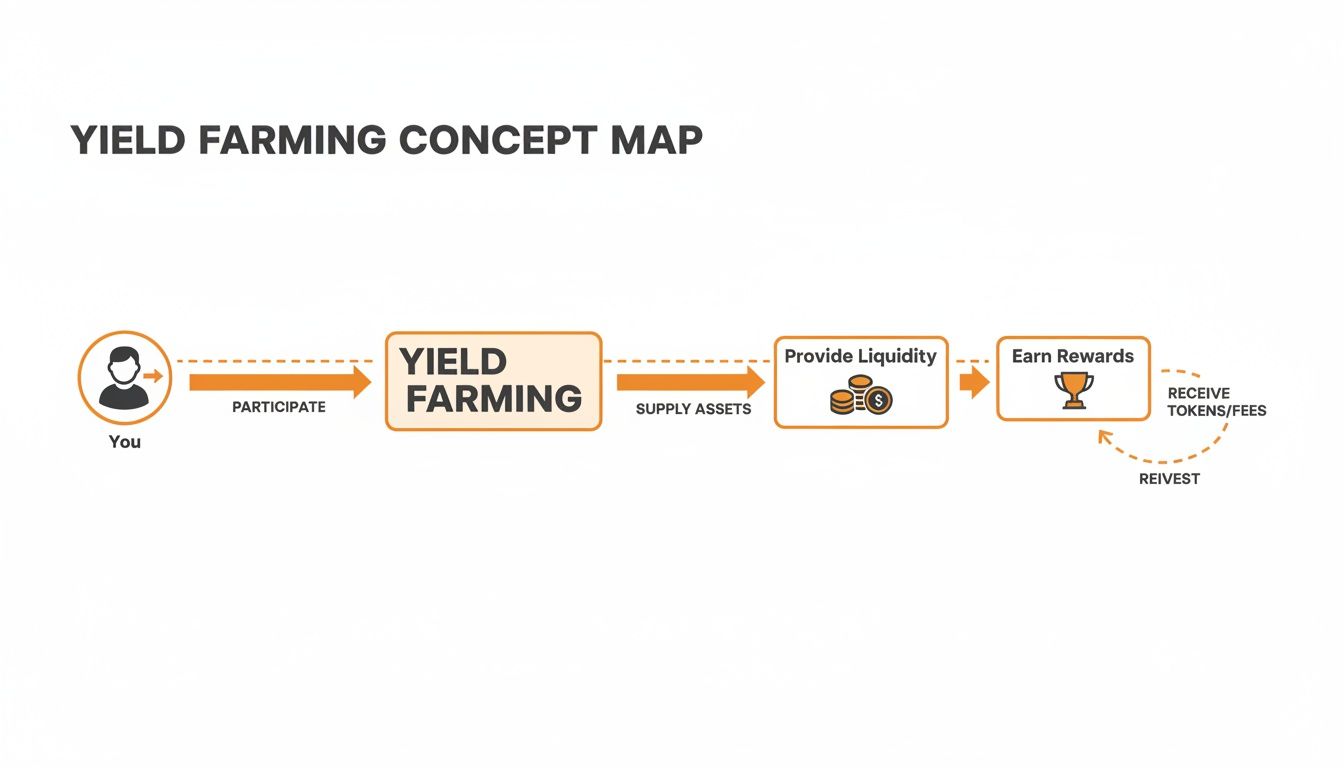
As you can see, you are an active participant, providing the liquidity that fuels the DeFi economy and getting rewarded for it.
Many DeFi platforms are hungry for your liquidity, so they offer extra incentives through something called liquidity mining. This means taking your LP tokens and "staking" them in a special farm or vault on the platform.
- Staking here just means locking up your LP tokens as proof that you’re a committed liquidity provider.
- By doing this, you show the platform you’re helping it grow.
- As a thank you, the platform pays you extra rewards, usually in its own native token (like UNI from Uniswap or CAKE from PancakeSwap).
This second layer of rewards is what transforms a decent return from trading fees into a potentially much higher APY. You're effectively earning in two ways at once: from the trading fees and from the extra staking rewards. This double-dip incentive is the secret sauce behind many of the most popular and profitable yield farming strategies out there.
Navigating the Key Risks of Yield Farming
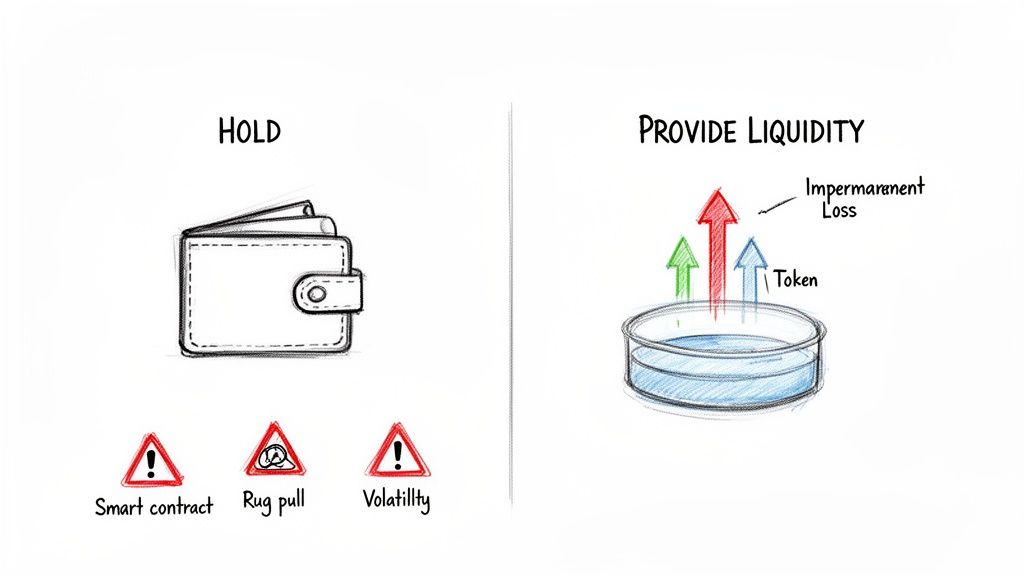
Those amazing returns in yield farming don't come for free. For every opportunity, there’s a risk, and going into this space without a solid understanding of the dangers is a sure way to lose your money. Think of it less as a get-rich-quick scheme and more as high-stakes digital gardening—it needs knowledge, attention, and a healthy respect for what can go wrong.
Let’s be clear: the risks are real. But by understanding them, you can make smarter decisions. One of the first hurdles for any new liquidity provider is getting their head around impermanent loss.
Understanding Impermanent Loss
This is probably the most confusing risk in all of DeFi. It isn’t a loss in the way you might think, like your tokens being stolen. It’s an opportunity cost that happens when you provide liquidity and the prices of your deposited tokens change at different rates. Simply put, it's the difference between the value of your assets in the pool versus what they’d be worth if you’d just held them in your wallet.
So, how does it happen? Automated Market Makers (AMMs) are built to keep a constant balance of value (usually 50/50) between the two tokens in a liquidity pool. When one token's price shoots up, the protocol rebalances by selling it to buy the other, weaker token.
Here’s a real-world example to make it clear:
- You deposit 1 ETH and 2,000 USDC into a pool. At that time, ETH is worth £2,000, so your total stake is valued at £4,000.
- Suddenly, ETH doubles in price to £4,000.
- To keep the pool balanced, smart traders swoop in and buy the now "cheaper" ETH from your pool, replacing it with USDC.
- If you pull your funds out now, the pool might give you back something like 0.707 ETH and 2,828 USDC. Your total value is now £4,242. Not bad.
- But wait. If you had just held your original assets? You'd have 1 ETH (now worth £4,000) plus 2,000 USDC, for a total of £6,000. The difference of £1,758 is your impermanent loss.
The term "impermanent" is used because this loss is only locked in when you withdraw your liquidity. Often, the trading fees and farming rewards you earn are meant to cover it. But in a very volatile market, those earnings might not be enough. To dig deeper, check out our full guide on understanding impermanent loss for DeFi liquidity providers.
Smart Contract Bugs and Exploits
Yield farming platforms are powered by smart contracts, which are just bits of code that run automatically on the blockchain. While they make this whole world possible, they can also have bugs or weaknesses. Hackers are always looking for these flaws, hoping to drain a platform of its funds.
Even the most famous platforms with billions locked away aren't completely safe. A single undiscovered bug could be used by a hacker, possibly leading to a 100% loss for everyone who provided liquidity. For example, a bug found in a lending protocol could allow a hacker to borrow all the assets without putting up any collateral, leaving the lenders with nothing.
A crucial piece of advice: stick to platforms that have been through multiple security audits from well-known firms like CertiK or Trail of Bits. An audit isn't a 100% guarantee, but it’s a strong sign that the project team takes security seriously.
Rug Pulls and Project Risks
Beyond technical problems, you have to watch out for human-made risks—especially the dreaded "rug pull." This is a scam where a project's developers, often anonymous, suddenly disappear and run off with all the investors' money. They do this by taking all the liquidity out of the pool, which instantly makes their native token's value drop to zero.
These scams often lure users with promises of crazy APYs that seem too good to be true. And they always are. Here's how to better protect yourself:
- Stick to the Blue Chips: New, unproven farms are tempting, but it's much safer to work with well-known platforms like Uniswap, Aave, or Curve. Their long history and huge user base speak for themselves.
- Check the Team: Is the founding team public and open about who they are? Anonymous teams are a big red flag.
- Look at the Tokenomics: Check the token distribution. If the developers hold a huge percentage of the supply, they can easily sell it all on the market and crash the price.
By keeping these main risks—impermanent loss, smart contract bugs, and rug pulls—at the front of your mind, you can approach your yield farm crypto strategy with the right amount of caution. The golden rule of crypto applies here more than ever: never invest more than you’re willing to lose.
Popular Yield Farming Strategies You Can Use
Alright, now that we've got the theory down, let's talk about putting it into practice. To successfully yield farm crypto, you have to match your strategy to your goals and how much risk you can handle. There's no single "best" method here. It’s all about what rewards you're after and the kind of ups and downs you can stomach.
Some approaches are safer, designed for steady, predictable earnings. Others are much more aggressive, chasing those amazing returns but with a lot more on the line. Figuring out where you fit on that scale is the first step to finding your way in the wild world of DeFi.
Low-Risk Farming With Stablecoins
For anyone just starting out, or for those who simply want to protect their capital, farming with stablecoins is the best entry point. The strategy is simple: you provide liquidity to a pool made up of two stablecoins, like USDT/USDC or DAI/USDT. Because these tokens are designed to hold their value against an asset like the US dollar, their prices don't really move.
This stability almost completely removes the risk of impermanent loss, which is a big headache when dealing with more volatile crypto pairs. The trade-off, of course, is that the returns are much lower, usually landing somewhere in the 2% to 10% APY range. It's not going to make you rich overnight, but it’s a dependable way to earn a yield without constant worry.
A great place to see this in action is on a platform like Curve Finance. Curve is a decentralised exchange built specifically for swapping similar assets with very little price change, which makes it the perfect home for stablecoin pools. By depositing your stablecoins there, you start earning a share of the trading fees and often get bonus rewards in their native CRV token.
Higher-Risk Farming With Volatile Pairs
If you have a bigger appetite for risk and are chasing higher returns, then farming with volatile token pairs will be more your style. A classic example would be providing liquidity for a popular pair like ETH/SOL or even BTC/ETH. The prices of these assets can swing wildly, which means the potential for impermanent loss becomes a very real and significant risk.
So, why bother? The rewards are often far bigger to make up for that extra risk. It's not unusual to see APYs on these pools ranging from 20% to over 100%. These returns are driven by high trading volumes and generous token rewards offered by the platform. Uniswap is the giant in this space, acting as a massive hub for thousands of different token pairs and countless volatile liquidity pools.
It’s a classic risk-reward situation. The higher potential APY is meant to compensate you for the chance that the value of your deposited assets might do worse than simply holding them. Always think about if the rewards are worth the risk of impermanent loss.
Platform-Specific Strategies
Beyond just the tokens you choose, the platform itself shapes your strategy. Each one has its own unique style and focus.
Lending and Borrowing on Aave: Think of Aave as a decentralised money market. Here, you can deposit a single asset—like ETH or USDC—and earn interest from people who borrow it. It's a much simpler form of yield farming since you don't have to manage a pair of tokens. For example, you could deposit your USDC and earn a steady interest rate, which is a very low-risk way to start.
Optimised Swaps on Curve: As we mentioned, Curve is the king of stablecoin swaps. Its whole system is built for low-slippage trading between similar assets, which attracts huge trading volume and creates a steady stream of fees for its liquidity providers.
Massive Variety on Uniswap: Uniswap is the jack-of-all-trades. You can find a liquidity pool for almost any token pair you can think of, from established blue-chip cryptos to brand-new, highly risky projects. This makes it a great playground for trying out different risk levels.
Comparison of Common Yield Farming Strategies
To help you see the options, here's a quick breakdown of how these different approaches compare.
| Strategy Type | Example Pair | Risk Level | Typical Return | Popular Platforms |
|---|---|---|---|---|
| Stablecoin LP | USDC/DAI | Low | 2% - 10% APY | Curve Finance, Convex |
| Volatile LP | ETH/SOL | High | 20% - 100%+ APY | Uniswap, SushiSwap, Balancer |
| Single-Asset Lending | Supply ETH | Very Low | 1% - 5% APY | Aave, Compound |
This table makes it clear: your choice ultimately comes down to a trade-off between risk and potential reward. There's no right or wrong answer, only what's right for your personal financial situation and goals.
While Bitcoin has the highest recognition in the UK at 79%, it's worth noting that Ethereum is a major portfolio component for 43% of crypto investors. The rising recognition of stablecoins, now at 53%, also shows a growing interest in the very assets that are central to these farming strategies. You can find more insights on UK crypto trends and their regulatory context over at dig.watch.
The best way forward is to start with a platform and strategy that feels comfortable. You can always try more complex strategies as you build up your knowledge and confidence.
Your Practical Checklist for Getting Started
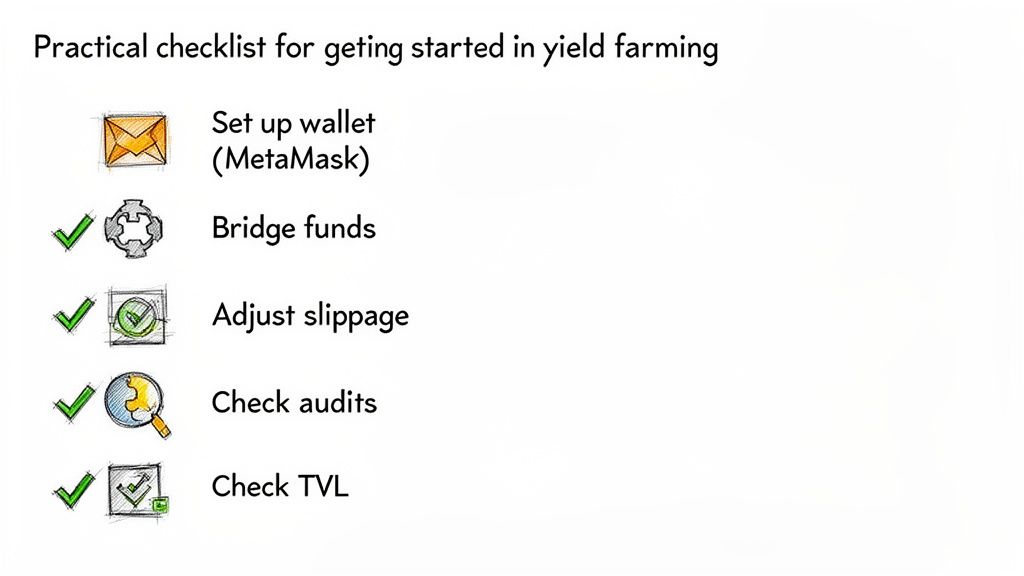
Jumping into DeFi can feel like a lot at once, but breaking it down into a few simple steps makes all the difference. This is the exact checklist I use myself—think of it as a pre-flight inspection before you yield farm crypto.
Before you can do anything in decentralised finance, you need a way to connect to dApps and a place to hold your assets. That means getting a self-custody wallet.
1. Set Up a Compatible Crypto Wallet
Your wallet is your passport to the entire DeFi world. Unlike holding coins on a centralised exchange, a self-custody wallet means you—and only you—have control of your private keys and your funds.
For anyone just starting, MetaMask is the best choice. It works as a browser extension or mobile app and is supported by almost every DeFi platform you'll find. The setup is simple, but there's one golden rule: write down your seed phrase and store it somewhere safe and offline. Seriously. Never, ever share it.
2. Move Funds and Use a Blockchain Bridge
Okay, wallet’s set up. Now you need to get some crypto into it. You can often buy directly inside MetaMask or just send assets over from an exchange. But there's a catch: transaction costs, or 'gas fees', on networks like Ethereum can be painfully high and can eat up your potential profits.
This is where blockchain bridges come in. A bridge is a tool that lets you move your assets from one network to another, like from the expensive Ethereum mainnet to a much cheaper Layer 2 like Polygon or Arbitrum.
For instance, using a bridge like Hop Protocol or Stargate, you could move your USDC from Ethereum to Polygon. That transaction might cost you a few pounds, whereas doing the same on Ethereum could set you back £30-£50 during busy times. It’s a huge help, especially if you’re not working with a massive amount of money.
3. Understand Slippage Tolerance
When you swap tokens on a decentralised exchange, the price can sometimes move in the few seconds between clicking 'swap' and your transaction being confirmed on the blockchain. We call this tiny price change slippage.
Most platforms let you set your slippage tolerance, which is just the maximum price change you’re willing to accept.
- A tight tolerance (like 0.5%) protects you from a bad price but might cause your swap to fail if the market is moving quickly.
- A looser tolerance makes sure the trade happens, but you might get a slightly worse deal than you first saw.
As a general rule, a slippage of 0.5% to 1% is a good starting point for most trades with common tokens.
4. Conduct Your Safety Checks
This is the most important step of all. Don't skip it. While DeFi is full of amazing innovation, it’s also a magnet for scams and poorly-built projects. Before you deposit a single penny, you need to do your homework.
Has the project been audited? Good projects pay for independent security audits to check their code for problems. Look for audit reports on their website from well-known firms like CertiK, Trail of Bits, or OpenZeppelin.
What's the Total Value Locked (TVL)? TVL is the total amount of money users have locked into a platform. You can check this on analytics sites like DeFiLlama. A high and steady TVL (over £100 million) is a great sign of trust and long-term stability.
Is the APY realistic? Be very careful of any project promising crazy returns like 1,000%+ APY. These numbers are usually not sustainable and a classic hook for a "rug pull," where developers simply vanish with everyone's money.
A project with a transparent team, multiple security audits, and a healthy TVL is a much safer bet than an anonymous project promising unbelievable gains. Trust is earned through openness and a proven track record.
By carefully working through these steps, you build a solid foundation to yield farm crypto. It’s not about chasing the latest hype; it’s about making smart, secure decisions from day one.
UK Tax and Regulation for Crypto Farmers
As you start yield farming in the UK, it's vital to get your head around the rules from His Majesty's Revenue and Customs (HMRC). While those high APYs are what draw us in, getting the tax wrong can turn a profitable year into a big problem. The crypto rulebook is still being written, but the main tax principles are already in place.
When you yield farm crypto, any rewards you earn are generally seen as income. Think of it this way: HMRC views those reward tokens as a form of payment. This means you’ll likely owe Income Tax on their value in pounds on the very day they arrive in your wallet.
Two Types of Tax to Consider
Getting your tax affairs in order means understanding the two main taxes that can apply to your yield farming.
- Income Tax: This applies to the rewards you earn from staking or providing liquidity. HMRC classifies this as miscellaneous income, which is taxed at your standard income tax rate.
- Capital Gains Tax (CGT): This one comes into play later. When you sell, swap, or even spend your reward tokens, any increase in their value from the day you received them is a potential capital gain.
For example, say you earn a reward token worth £50. You need to declare that as income. If you hold onto it and later sell it for £150, you've made a £100 capital gain that might be subject to CGT.
The Importance of Meticulous Record-Keeping
Here’s the tricky part: because of how this works, keeping detailed records isn't just a good idea—it's essential. For every single transaction, you have to log:
- The type and amount of crypto you received as a reward.
- The date you received it.
- The reward's value in Great British Pounds (£) on that specific day.
- What you did with the token later (sold, swapped, etc.) and its value at that point.
A Quick Disclaimer: Please remember, this is for educational purposes and isn't financial or tax advice. The rules are complex and can change. We can't stress this enough: talk to a qualified UK tax professional who understands crypto to make sure you're fully compliant.
On the rules front, things are slowly getting clearer. The Financial Conduct Authority (FCA) has brought in regulations requiring crypto firms to register and follow anti-money laundering standards. This has actually helped get rid of some of the riskier businesses, giving everyone a bit more confidence in the legitimate platforms that remain, as detailed in analysis from imarcgroup.com.
There's even been some good news recently from HMRC. For certain DeFi activities, new guidance has simplified things for liquidity providers. You can read more about the no gain, no loss treatment for DeFi deposits, which is a welcome development. In this game, staying informed is your best strategy.
Common Questions About Yield Farming
Alright, we've covered a lot of ground, and it's completely normal if you still have a few questions. To make sure you feel ready to move forward, let's go through some of the most common questions I hear from people just getting started with yield farm crypto.
Is Yield Farming the Same as Staking?
That's a great question. They’re related, but not the same thing. Staking is usually a simpler process where you lock up a single cryptocurrency to help secure a blockchain network. For example, you might stake ETH to help validate transactions and earn a modest reward. It's a bit like earning interest for helping to keep the system running.
Yield farming is the broader, more active search for the highest possible returns. It usually involves more complex strategies, like providing a pair of assets to a liquidity pool. Think of staking as having a steady job, while yield farming is more like being a financial freelancer, always looking for the most profitable gigs.
How Much Money Do I Need to Start Yield Farming?
There isn't an official minimum, but you need to be realistic about costs. On a network like Ethereum, where transaction fees (or 'gas') can be high, starting with less than a few hundred pounds often means your potential gains get eaten up by fees.
However, on more affordable networks like Polygon or Arbitrum, you can get started with much less. For example, you could begin with £50 or £100 just to learn how it works. The most important rule, though, is universal: only invest what you are completely prepared to lose. This is vital, especially while you're still learning. It’s always best to start small and grow as you gain confidence.
Remember, the flashy APY you see on a platform is a moving target, not a guarantee. It’s a highly variable number that can drop in an instant due to token price swings or more people joining the pool. A sky-high APY is often a major red flag for sky-high risk.
What Is APY in Yield Farming?
APY is short for Annual Percentage Yield. In theory, it’s the total return you could expect on your investment over a full year if you kept reinvesting your earnings (a process known as compounding).
But in the world of DeFi, you have to take this number with a huge grain of salt. The APY displayed is just a snapshot in time, not a fixed-rate promise. It can and will change dramatically based on a few key factors:
- Token Price Volatility: If the price of the token you're earning as a reward crashes, your real-world returns will crash right along with it. For instance, if you're earning a farm token worth £1 and its price drops to £0.10, your actual APY has effectively been slashed by 90%.
- Pool Popularity: When more people pour money into a farming pool, the rewards get split between more participants, shrinking everyone's share.
- Incentive Programmes: Many platforms launch with temporary, high-reward promotions to attract users. Once these special rewards end, the APY often drops dramatically.
Always treat APY as a current estimate of what's possible, not what's promised.
How Can I Track My Yield Farming Profits?
Keeping good records is absolutely essential. Not just for knowing if your strategy is working, but also for when it's time to do your taxes. Trying to track everything manually in a spreadsheet is a recipe for a headache.
Thankfully, some brilliant tools can do the hard work for you. Portfolio trackers are your best friend here. Platforms like Zapper or DeBank let you connect your crypto wallet and get a clean, single dashboard of all your DeFi positions and earnings across different platforms.
When it comes to taxes in the UK, using a special crypto tax tool like Koinly or CoinLedger is almost a necessity. These services can pull your entire transaction history and help generate the reports you'll need for HMRC, saving you an incredible amount of time and effort.
Ready to put your knowledge into practice? The Coin Course offers over 50 expert-written articles and practical guides to help you navigate the world of crypto with confidence. Whether you're a beginner or an experienced investor, our resources are designed to accelerate your crypto journey. Start learning today at https://thecoincourse.com.