Blockchain security keeps the shared ledger honest, but it does not stop a valid signature from spending coins after a scam, a stolen key or a bad contract.
The familiar advice to trust the blockchain leaves out the most important question: trust it to do what? A network can record your payment correctly while the person receiving it is a fraudster.
For a UK beginner, the useful distinction is not just secure versus insecure. It's the difference between a reliable record, a trustworthy provider, and a decision you can safely authorise.
What Blockchain Security Actually Protects
Blockchain security means the controls that keep a shared transaction record trustworthy.
Think of a club ledger copied across members' computers. Members accept new entries according to shared rules, and changing an old entry would require replacing the accepted history across the network. That makes quiet edits difficult, but it doesn't prevent someone agreeing to a bad payment.
The scale matters: the FCA's cryptoasset consultation describes an estimated 4.5 million UK adults, 8% of the population, owning cryptoassets in August 2025, while 10% of cryptoasset consumers reported losing money through fraud and another 17% reported being targeted without losing money.
What blockchain security covers and what it leaves open
| Place | What is covered | What can still go wrong |
|---|---|---|
| Shared ledger | Agreed history that is hard to rewrite quietly | A payment you approved by mistake stays valid |
| Private key and recovery phrase | A signature can be checked without revealing the key | Phishing, a photo of the phrase, or malware spends the coins |
| Wallet app or browser | Local checks if the software is the real one | A fake extension or a bad approval screen |
| Exchange or custodian | That firm's own locks, logs and staff rules | Insolvency, insider theft or frozen withdrawals |
| Advert or investment offer | UK marketing rules where they apply | A polished scam or a promised high return |
| Smart contract | Code runs according to its written rules | A bug, a trap or an unlimited token approval |
For developers, the surrounding website deserves separate testing. GoReplay's guide to assess your application's security is relevant because a sound blockchain doesn't make its web interface safe.
Working rule: Check both the record and the decision. They answer different questions.
The Three Building Blocks of a Secure Chain
Say Priya in Leeds sends a cryptoasset payment to a supplier. Her wallet prepares the transaction, signs it and sends it to the network. Several different controls must work before that payment becomes part of the accepted record.
Cryptography and the signing key
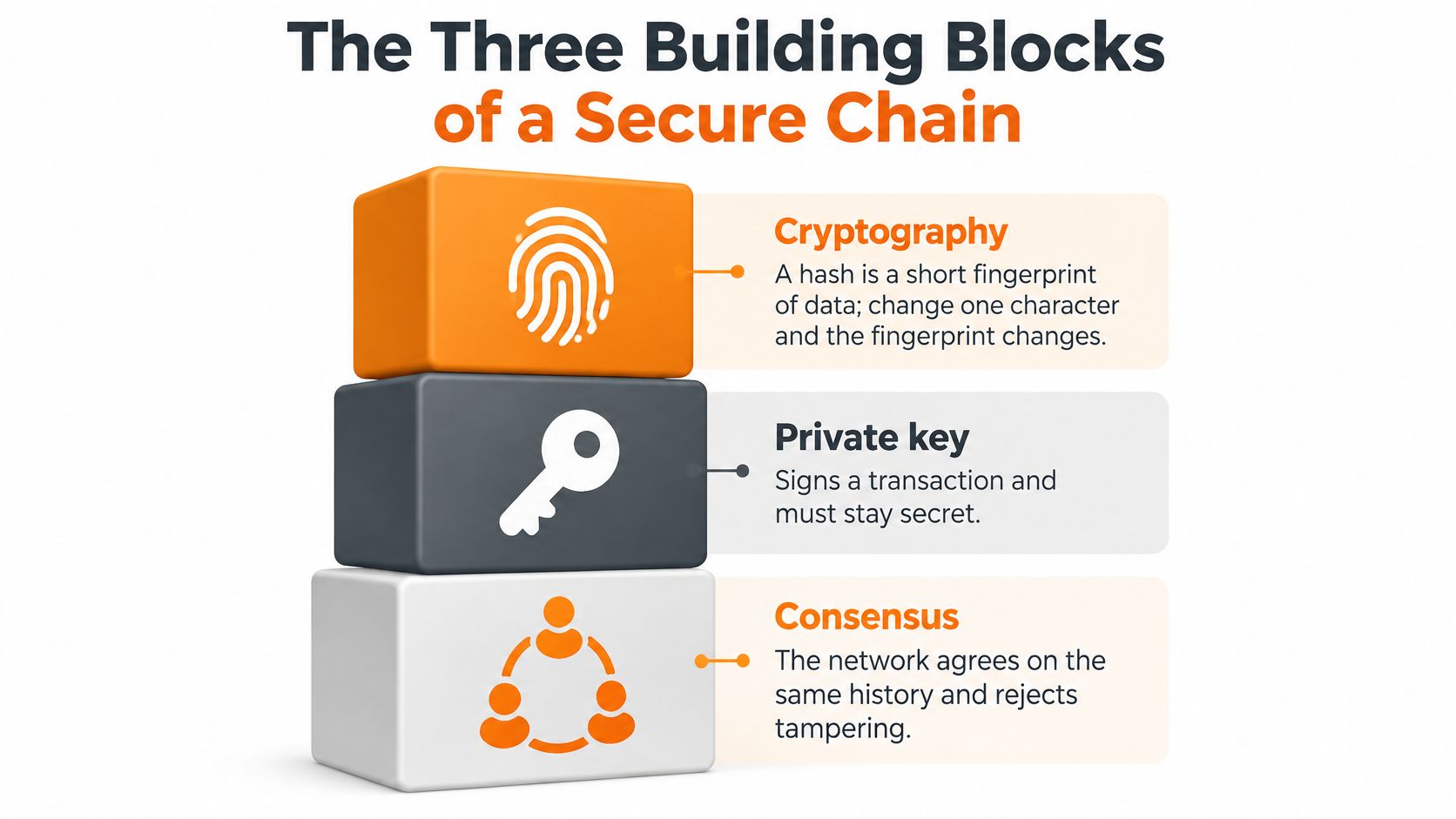
A hash is a short digital fingerprint of data. Change the data and its fingerprint changes, making hashes useful for detecting alterations and linking blocks together.
Hashing isn't the same as encryption. Encryption hides information from people without the right access; a hash helps someone check whether information matches an expected value. Public blockchain payments aren't automatically private.
Priya's private key performs another job: it creates a signature authorising a transaction. Other computers can check that signature using public information without learning her secret key.
The padlock comparison helps, within limits:
- Public address: Like a visible delivery slot, it tells someone where they can send assets.
- Private key: Like the secret means of opening the lock, it grants control and must stay private.
- Recovery phrase: A backup from which wallet keys can be recreated, not a password a support agent needs.
The graphic separates these jobs visually.
Consensus and the network carrying the message
Consensus is how participating computers settle on an accepted history. Without it, different computers could disagree about whether Priya had already spent the same coins.
Bitcoin-style proof of work makes block production costly through computation. Proof of stake uses assets committed by validators, together with protocol rules and penalties. Their attack conditions differ, so a simple majority isn't a universal description of every network's security.
The underlying problem is agreement among participants who may fail or behave maliciously. The Coin Course's explanation of Byzantine fault tolerance develops that idea without assuming everyone in the network is trustworthy.
Nodes also need to pass transactions and blocks between themselves. Priya's wallet usually reaches the network through an endpoint, which is a server supplying blockchain information. A dishonest endpoint can mislead her screen without changing what independent nodes hold.
That is why layered controls matter. The guide to defense in depth with Vigil Security provides useful context for combining protections rather than relying on a single barrier.
A confirmed block is evidence of an authorised transaction, not evidence that the signer understood the deal.
Where Losses Happen Without Breaking the Ledger
A familiar trick begins with reassurance rather than technical force. Someone posing as support says your wallet needs fixing, then sends you to a convincing page that asks for a signature.
The attacker doesn't need to defeat the network if you supply the authority they need. The important question is which part failed: agreement, software, access, information or custody.
Match the failure to the consequence
Common blockchain losses and what fails
| Risk | What fails | What stays intact | Usual result |
|---|---|---|---|
| Mining-power majority on a small proof-of-work chain | Recent block history | Your key and signature rules; deeper history isn't automatically rewritten | A recent payment can be double-spent |
| Smart contract bug | The program's intended rules | The signature check | Tokens move as the flawed code allows |
| Unlimited token approval | Limits on later control of that token | The chain's record | A later drain without a fresh send from you |
| Stolen key or recovery phrase | Exclusive access to signing authority | The cryptography | The thief can produce accepted signatures |
| Phishing or a fake wallet | The decision to sign | The ledger rules | A valid transfer to a scammer |
| False endpoint or routing trick | What the screen shows | The independent network | You approve an action you didn't mean |
| Exchange or custodian failure | The firm's promise to you | The underlying chain and any remaining on-chain assets | Withdrawals stop even though the chain is healthy |
A chain-history attack has a different scope from key theft. An attacker with enough block-producing power may replace recent payments with a competing history, but that doesn't reveal everyone's private keys. Smaller networks can be more exposed when an attacker can cheaply gather the necessary resources.
A smart contract is a program executed under the blockchain's rules. If its logic lets someone withdraw assets they shouldn't receive, validators may correctly execute a disastrous instruction. A code audit can help find faults, but it isn't a promise that none remain.
Access and account balances aren't the same thing
An unlimited token approval is more specific than handing over your whole wallet. It can let a designated spender move the relevant token, subject to the token and contract rules. Disconnecting a website from your wallet doesn't necessarily cancel that on-chain permission.
SIM swaps usually target another boundary. A criminal takes control of a phone number and uses it to intercept messages or reset an exchange account. They haven't broken a blockchain signature scheme; they've compromised the account-recovery process.
A custodial balance also needs careful reading. The number shown in an exchange app may be an entry in the company's internal books rather than assets controlled by your own key. Some internal account actions can be corrected by the provider, whereas a settled external transfer generally can't.
These dependencies are a form of third-party risk. A bridge operator, wallet extension, price-data provider or exchange can become the weak point even when the base network operates normally.
Before choosing a defence, identify the failure. A stronger password won't fix flawed contract logic, and a hardware wallet won't make an insolvent custodian able to honour withdrawals.
Three Losses That Look Different Up Close
Similar-looking empty balances can have very different causes. These hypothetical examples show why the first useful question isn't whether someone hacked the blockchain.
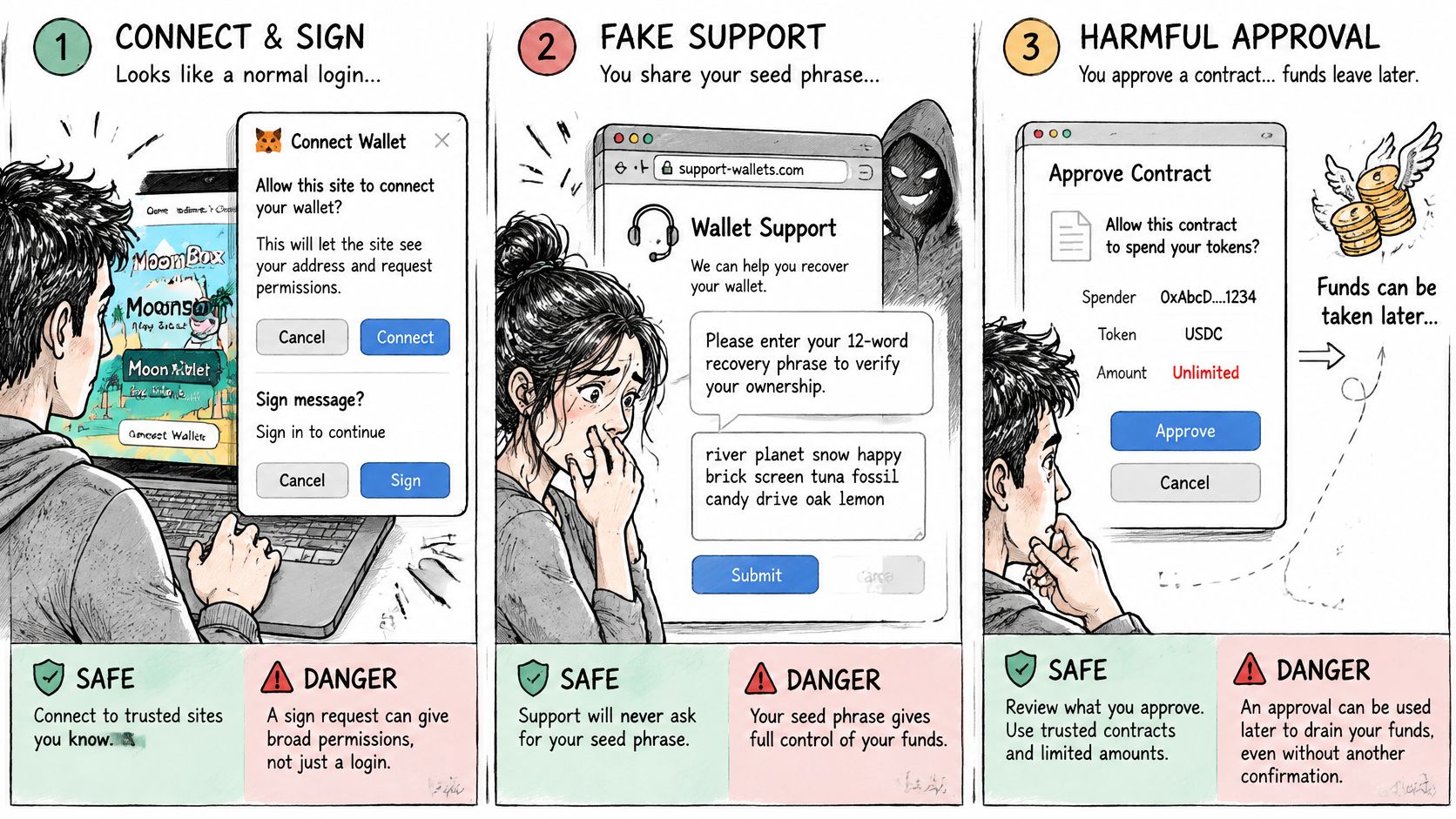
The image highlights common requests that should make a wallet user pause.
The permission that looked like a login
A collector in Manchester connects a wallet to a busy-looking token website. The prompt appears to be part of signing in, but it grants a contract permission to spend a token. Later, that permission is used.
The useful evidence includes the approval transaction, the spender address and the token allowance. A block explorer such as Etherscan can show these details on Ethereum, although a transaction record doesn't reveal whether the website's promises were honest.
- What failed: The collector misunderstood the authority being granted.
- Who could reverse it: The collector may revoke an active allowance, but that doesn't retrieve tokens already transferred.
- Damage-limiting habit: Use a separate wallet for unfamiliar applications and grant only the permission needed.
The bridge with concentrated signing power
Consider a bridge that releases assets when its designated signers approve a withdrawal. An attacker compromises enough of those signers, and the bridge accepts the resulting authorisation.
No ordinary user's recovery phrase needs to be stolen in this scenario. The concentration of authority at the bridge matters more than how widely distributed the underlying blockchain is.
- What failed: The bridge's signing and operational controls.
- Who could reverse it: Operators might pause remaining withdrawals if the design permits, but recovery of transferred assets isn't assured.
- Damage-limiting habit: Avoid keeping assets in a bridge longer than necessary, and examine who can authorise releases.
This video offers another way to follow the security concepts.
The exchange balance that couldn't be withdrawn
A UK customer leaves savings on a trading platform because the app looks familiar and withdrawals have always worked. The firm later freezes withdrawals after a shortfall becomes apparent.
A blockchain explorer cannot settle whether the company owes customers more than it holds. Even visible wallets don't, by themselves, establish the firm's complete liabilities or customers' legal rights.
- What failed: The custodian's financial or operational arrangements.
- Who could reverse it: Administrators or courts may handle claims, but an app balance isn't an immediate recovery guarantee.
- Damage-limiting habit: Keep trading funds separate from assets you don't need on the platform.
A stranger promising to fix any of these losses for an upfront payment should trigger a stop, not another transfer.
What UK Rules Change and What Stays With You
Regulated doesn't mean safe from every loss. UK rules can constrain how firms advertise and handle business, but they don't turn a risky asset into a protected savings account.
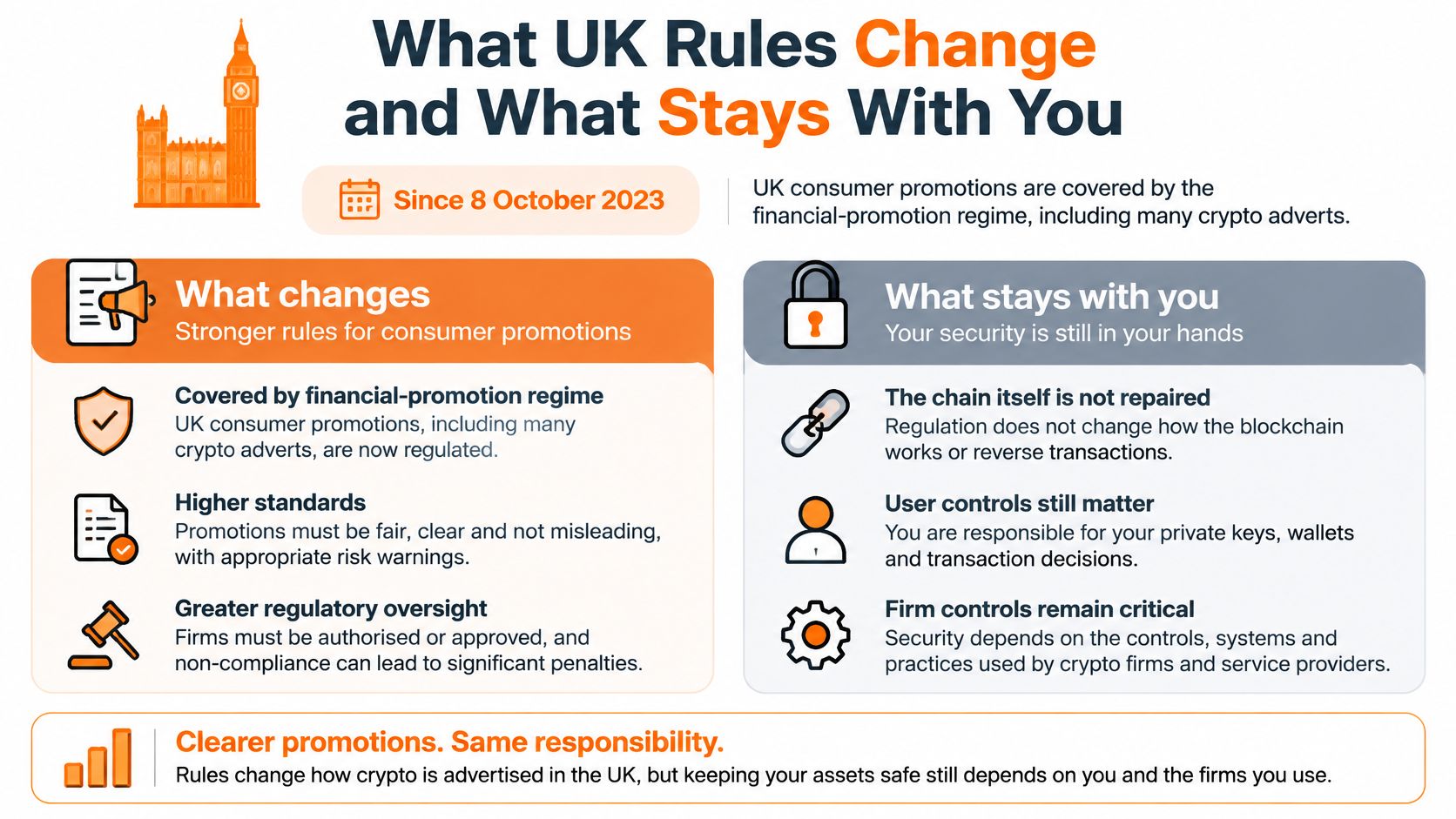
Since 8 October 2023, cryptoasset promotions aimed at UK consumers have fallen within the financial-promotion regime, including promotions from overseas firms, according to the FCA's financial promotions report.
Marketing controls and provider checks
A lawful promotion generally needs an applicable route:
- Authorised communication: An authorised person communicates it.
- Approved promotion: An authorised person approves an unauthorised person's promotion.
- Registered-business exemption: An FCA-registered cryptoasset business relies on the Money Laundering Regulations exemption.
- Another exemption: The promotion meets a relevant Financial Promotion Order exemption.
For covered direct offers, requirements taking effect on 8 January 2024 included personalised risk warnings, a 24-hour cooling-off period, client categorisation and an appropriateness assessment, as described in the FCA's quarterly promotions report. Appropriateness concerns the customer's knowledge and experience; it isn't personalised investment advice.
Enforcement doesn't mean every misleading promotion disappears: in the regime's first year, the FCA reported 1,702 alerts about illegal crypto promotions, more than 900 scam websites taken down and more than 50 apps removed.
The distinction between a firm's application and its actual status matters too. From January 2020 to 12 May 2025, the UK government's economic crime progress report records 372 applications to the FCA's cryptoasset AML regime; among 359 with outcomes, 14% were registered, 70% withdrawn, 4% refused and 12% rejected because insufficient documentation prevented assessment.
Registration concerns AML and counter-terrorist-financing supervision. It isn't a guarantee that customer assets cannot be lost.
Protection has a defined scope
The FCA's consumer research note reports that only 28% of cryptoasset users believed they could complain about a problem with their holdings in 2025, while awareness of FCA consumer alerts was 38%, and describes full commencement of rules covering custody, trading platforms, dealing, arranging and staking as scheduled for 25 October 2027.
That commencement date is a future schedule, not protection to assume is already available. Check the provider's current permissions and the particular activity involved.
Authorisation doesn't stabilise token prices, eliminate scams, guarantee stolen assets back or replace secure key management.
The Financial Services Compensation Scheme isn't a general crypto refund scheme. Nor should you assume that every complaint about crypto falls within the Financial Ombudsman Service's remit.
Checks for Holders Builders and Custodians
Good controls have a named owner. A holder can protect a recovery backup, but only a custodian can separate its customer assets properly, and only a builder can remove unnecessary powers from a contract.
Use the checklist to assign responsibility rather than assuming someone else handles security.
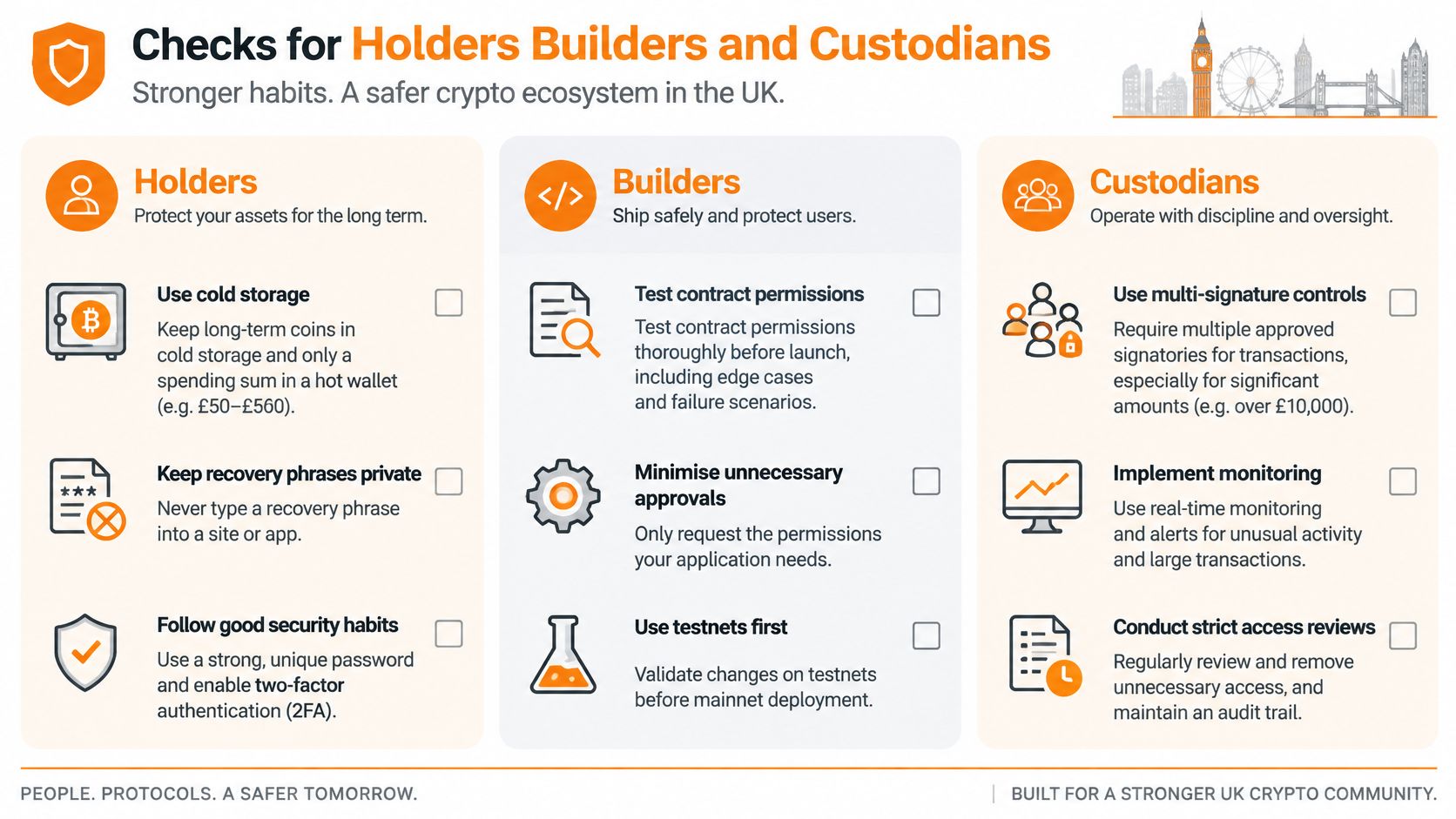
Holders
- Separate storage from spending. Keep long-term holdings in cold storage and a limited spending balance in a hot wallet. A hardware wallet still needs careful address and approval checks.
- Keep the recovery phrase offline. Never enter it into a website, support form or chat. Store the backup somewhere protected from theft, fire and accidental disposal.
- Verify the full destination. Compare the complete address using a trusted source, and check the asset and network. Don't rely only on matching the opening and closing characters.
- Reject unexpected prompts. Close the request and investigate independently. Use a trusted block explorer or allowance tool to inspect permissions rather than following a link from an unsolicited message.
- Preserve evidence after a loss. Save transaction hashes, addresses, messages and screenshots. Contact the exchange and bank promptly, report the fraud through the appropriate UK reporting route, and revoke unsafe allowances where possible.
- Pause under pressure. Step away from urgent offers. A genuine opportunity shouldn't require you to ignore checks or hide the transaction from someone you trust.
Builders
- Restrict administrative powers. Limit what privileged keys can change and add delays to sensitive operations so users can respond.
- Test failure paths. Check rejected transactions, compromised dependencies, unusual token behaviour and permission boundaries, not just successful transfers.
- Make approvals narrow. Prefer capped permissions that users can inspect and revoke. Explain the spender and asset in plain language.
- Publish verified source code. Let reviewers compare published code with the deployed contract. Verification supports inspection; it doesn't certify safety.
- Review external dependencies. Treat bridges and oracles, which supply outside information, as separate security assumptions.
Custodians
- Separate customer assets. Keep them apart from the firm's own funds, with clear accounting and reconciliation.
- Require independent approval. Use multi-signature controls and separate staff authorisation for significant movements.
- Display current regulatory status. State the relevant registration or authorisation accurately, rather than presenting an application as approval.
- Record meaningful evidence. Log transaction hashes, permissions and staff access, and investigate unusual activity.
- Explain recovery boundaries. Tell customers which internal actions can be corrected and which external transfers cannot.
Operational discipline matters as much as choosing a wallet. Use key-management best practices to organise access, backups and recovery before an emergency forces a rushed decision.
Choose the Protection You Will Actually Use
Choose a setup you can maintain on a bad day, not the one with the most impressive terminology. Self-custody suits someone willing to protect an offline backup and take responsibility for authorising transactions; custody suits someone willing to evaluate a firm and accept its withdrawal and failure risks.
Before choosing custody, inspect the firm's current FCA status and its explanation of segregated customer assets. Before choosing self-custody, make sure you understand how to restore access without exposing the recovery phrase.
Stop rule: No recovery phrase online, no unexpected approvals and no upfront payment to a stranger promising recovery.
Our library has 50+ articles covering blockchain technology. Start with these specific guides:
- Public vs. Private Keys in Bitcoin: Your Digital Identity: A Beginner guide taking 20 minutes, covering keys, cryptographic signatures and self-custody.
- Bitcoin Wallets: Hot Wallets vs. Cold Wallets Explained: A Beginner guide taking 18 minutes, explaining Bitcoin storage choices.
- How to Read Etherscan for DeFi: Tracking Transactions: A guide to tracing transactions, checking contracts and following token movements.
Practise a familiar transfer with a small test amount before committing more. Choose self-custody if you'll manage the keys; choose a custodian if you'll manage the provider risk.
The Coin Course offers structured guides to keys, wallets and account security, helping you connect blockchain concepts with practical checks. Visit The Coin Course and choose the guide that addresses your next decision before you move funds.