APY, or Annual Percentage Yield, is the true annual return on your money after compounding is factored in, and it is always equal to or higher than the stated interest rate. That sounds simple, until you're comparing savings accounts, tax bands, inflation, and even crypto products that borrow the same word but don't mean the same thing.
You might be staring at two offers right now, one with a shiny headline rate and one that looks a little duller. The confusing part is that the smaller number can sometimes leave you with more in your pocket, because the way interest is added changes the final result.
Why the Headline Rate Is Not the Whole Story
A saver opens two offers on a phone screen. One bank shows a neat headline rate, the other looks slightly lower, and the first one seems like the obvious pick. Then the fine print appears, the money compounds at different intervals, and the account with the lower-looking rate can end up paying more over the year.
That is the trap with simple headline rates. They tell you the starting point, not the full journey your money takes once interest starts earning interest. APY gives you the full-year picture, which is why it's the cleaner number when you want to compare like with like.
A snowball is the easiest way to think about it
Compounding works like a snowball rolling downhill. It starts small, then each turn picks up a little more snow, and the total grows faster than it would if you only added the same amount once.
With money, the snow is interest. Once interest is added to the balance, the next round of interest is calculated on a slightly bigger pile. That's why the annual percentage yield matters more than the bare rate printed on the front page.
Practical rule: If two offers don't compound in the same way, the headline rate alone can mislead you.
A good way to compare products is to ask one question. How much do I keep after a full year, not just what rate is advertised? If the answer isn't obvious, APY is the number that usually makes the comparison fairer.
For crypto products, that same question gets even more important because the yield may come from staking, lending, or token rewards rather than simple bank interest. A useful background guide on those risks is this explainer on the risks of DeFi and impermanent loss.
The APY Formula Explained with Real Numbers
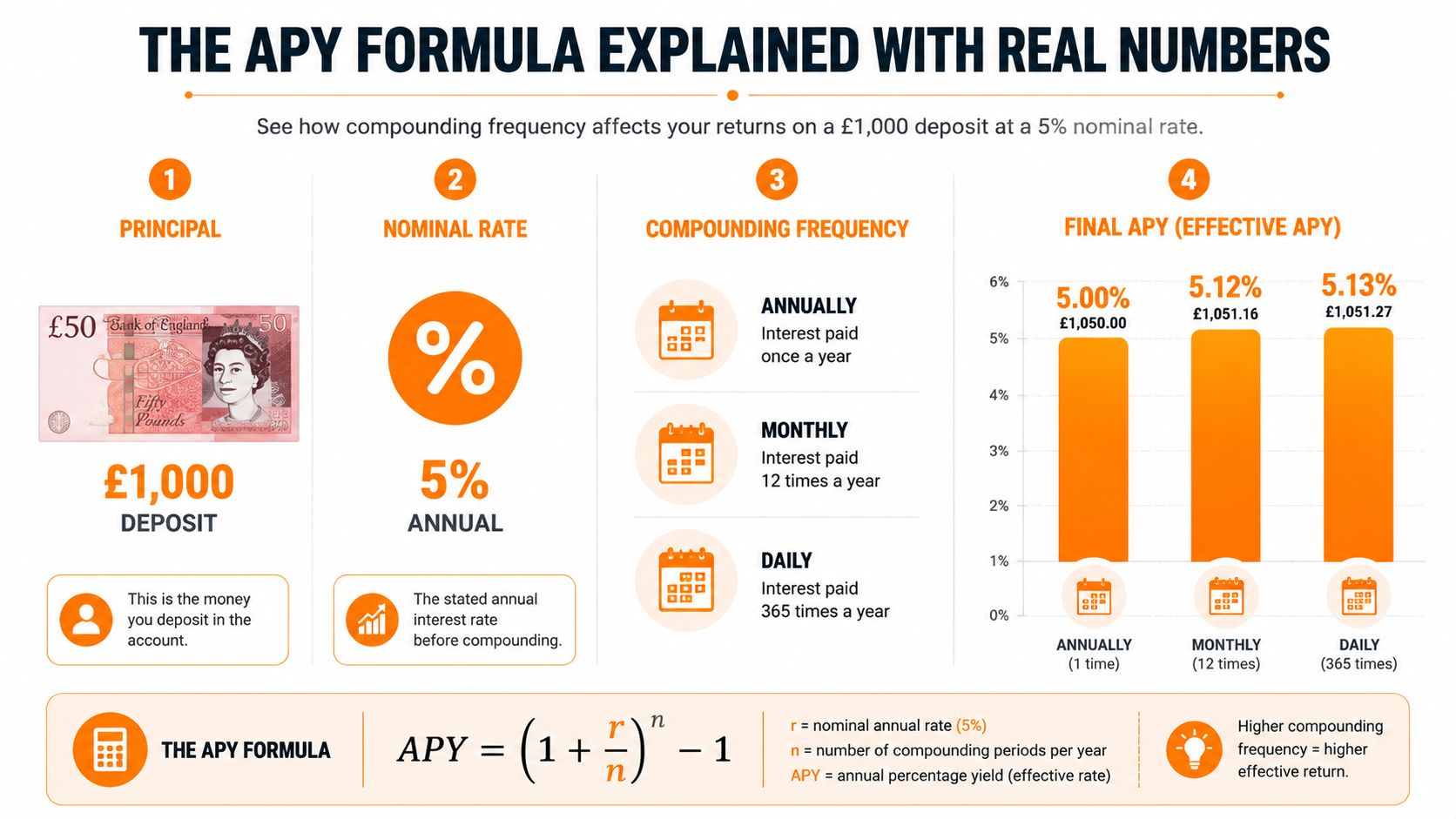
APY looks technical, but the idea is straightforward. You start with your deposit, apply the interest rate, and then let compounding do its work over the year.
Take £1,000 as a simple example. If a product advertises 5% annual interest, the final amount changes depending on how often interest is added. Annual compounding adds it once, monthly adds it every month, and daily adds it more often, so the balance grows a little faster each time.
The same rate can finish at different amounts
Here is the clean way to think about it, using the example numbers in the infographic.
| Compounding frequency | Effective APY | Final amount on £1,000 |
|---|---|---|
| Annually | 5.00% | £1,050.00 |
| Monthly | 5.12% | £1,051.16 |
| Daily | 5.13% | £1,051.27 |
The key point is not that the numbers are huge. The point is that more frequent compounding nudges the final return up, even when the stated annual rate stays the same. That is why one bank's “5%” can beat another bank's “5%” once you look at the yield, not just the rate.
If you want to model your own balance, an APY calculator can save time. Free tools are useful when you want to test compounding frequency, deposit size, and interest rate without doing the maths by hand. A clear walkthrough can help too, especially one that shows how the compounding logic works in practice, such as how Yield Seeker boosts your APY.
Keep the inputs simple, deposit, rate, and compounding frequency. If those three change, the final number changes.
APY vs APR and How to Tell Them Apart
APY and APR sound close, but they play different roles. APY is mainly the number you want when you're saving or investing, because it includes compounding. APR is the figure you usually care about when you're borrowing, because it shows the cost of the loan without dressing it up.
The easiest way to avoid confusion is to compare the same thing with the same thing. Compare APY to APY when you're saving. Compare APR to APR when you're borrowing.
A side by side check makes the difference obvious
| Metric | Formula Basis | Result on £10,000 | Used For |
|---|---|---|---|
| APY | Includes compounding | Higher effective return than the raw rate | Savings, deposits, yield products |
| APR | Excludes compounding | Lower than the equivalent APY in a savings context | Loans, credit cards, borrowing |
The important bit is how each number answers a different question. APY asks, “What do I keep after a year once compounding has been added?” APR asks, “What does borrowing cost me over a year before compounding effects are layered in?”
That difference matters because marketing often blurs the two. A savings ad might lean on APR language to sound familiar, while a loan ad may try to soften the cost by making the monthly payment look small. The rule is simple, if you're comparing savings offers, look for APY. If you're comparing debt, look for APR.
Quick check: If a product uses the wrong term for the job, slow down and read the full terms before you commit.
What You Actually Keep After UK Tax and Inflation
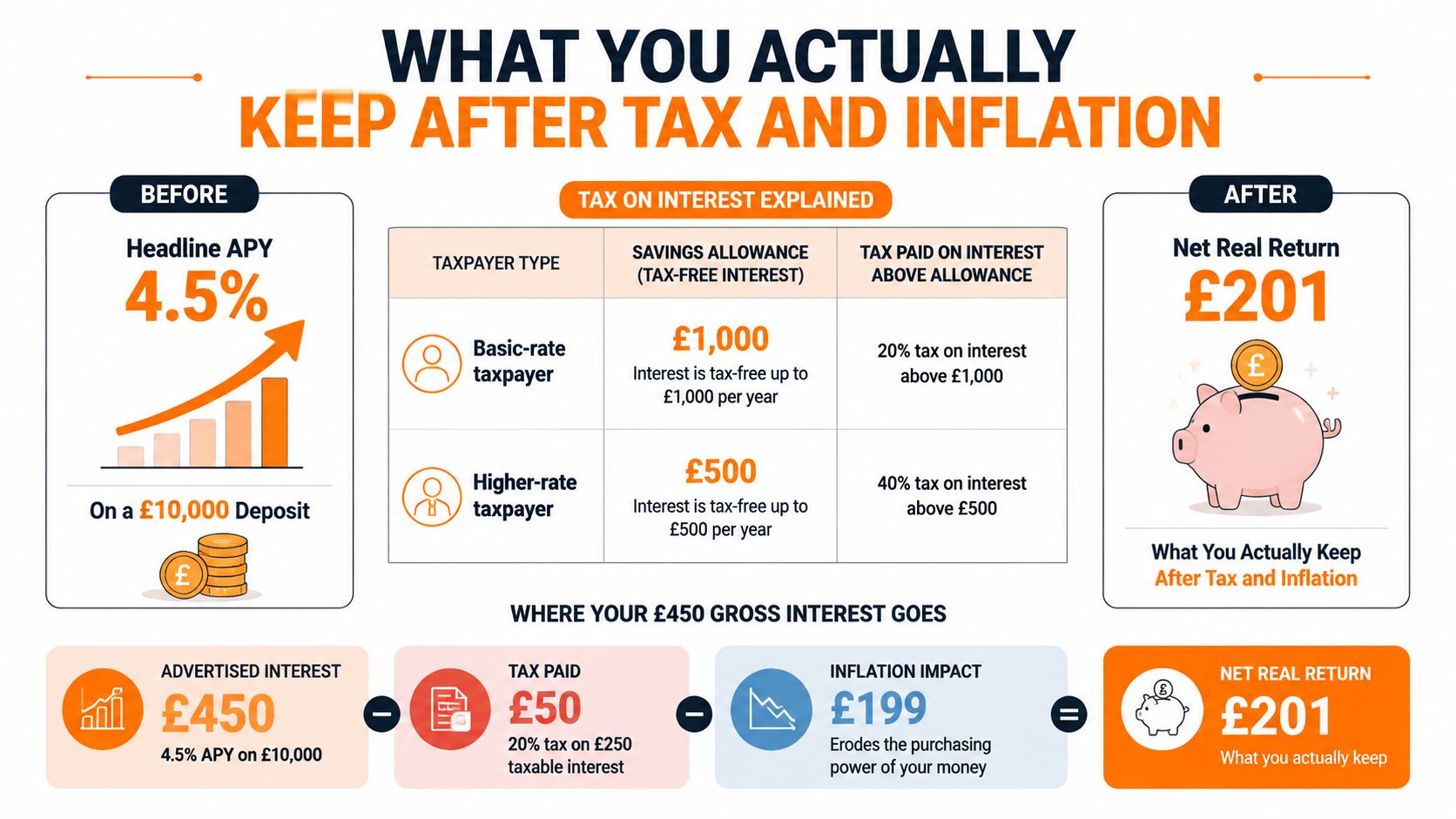
A headline APY can look healthy and still leave you disappointed. In the UK, the central question is not just what your account pays, but what you get to keep after tax and what that money can still buy after prices rise.
The UK personal savings allowance changes the picture. The standard allowance is £1,000 for basic-rate taxpayers, £500 for higher-rate taxpayers, and zero for additional-rate taxpayers. That means two people can earn the same APY on the same balance and walk away with very different net results because one pays tax on more of the interest than the other. For a plain guide to savings-interest tax rules, this breakdown on tax-free savings interest limits is a useful reference.
A simple three-step way to judge your own return
First, work out the interest your account is likely to pay before tax.
Second, check how much of that interest sits inside your allowance.
Third, compare the amount left after tax with inflation, because inflation tells you how far your money really goes.
That last step matters because inflation can eat away at purchasing power even when your balance goes up. The Bank of England's latest data show the CPI rate at 3.6% in June 2026, so a saver can still see a positive nominal APY while ending up with a negative real return after prices rise. In plain English, your statement balance may increase while your shopping basket gets more expensive at the same time.
A useful way to think about it is this. Nominal return tells you what the bank adds. Net return tells you what you keep. Real return tells you whether that money still buys as much as it did before.
A savings rate only matters in real life if it survives tax and still beats the cost of living.
Crypto APY and Why It Is Not the Same as Bank Yield
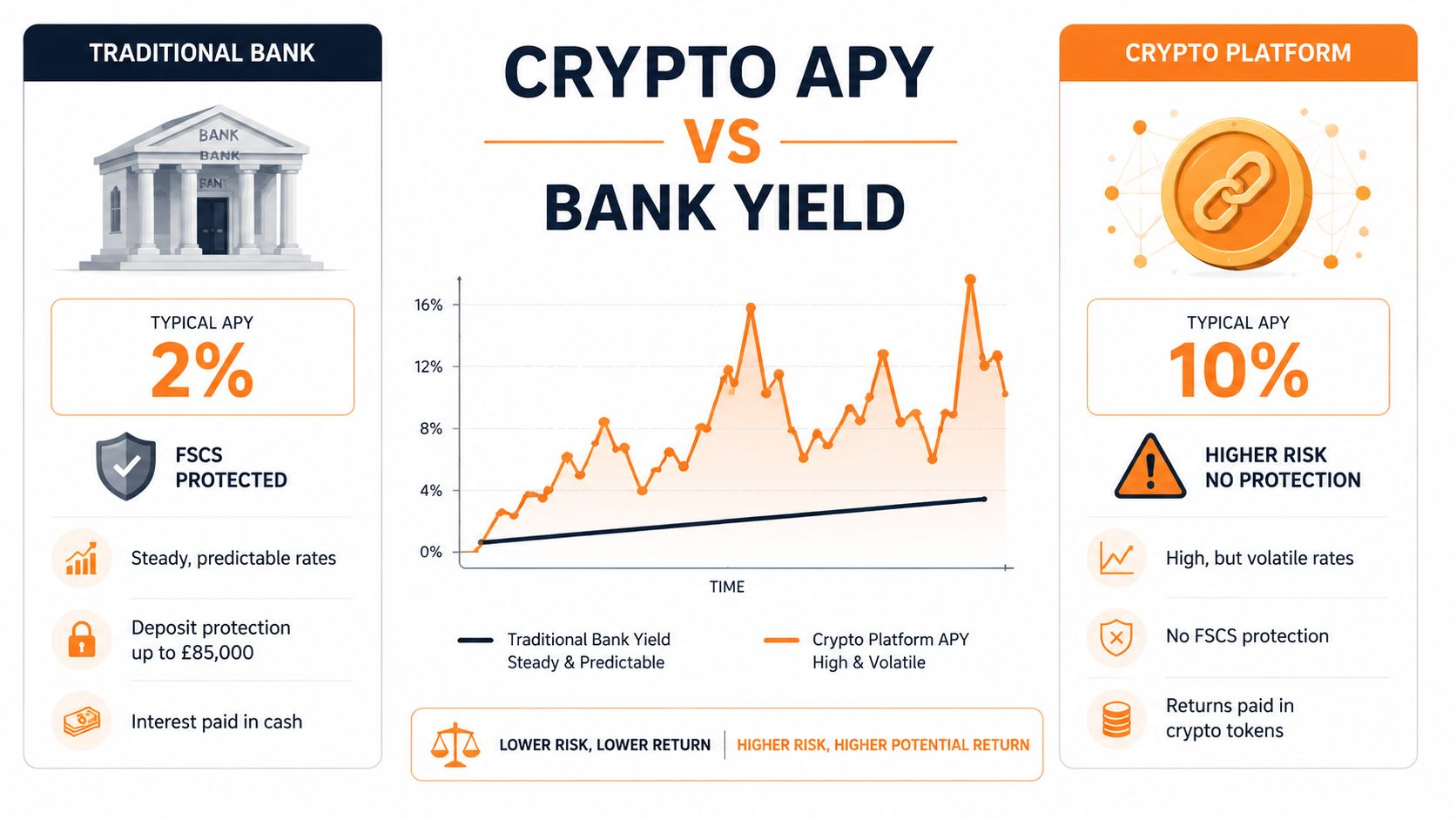
Crypto platforms use the word APY a lot, but the result is often nothing like a bank account. In a savings account, yield usually means cash interest credited on a deposit. In crypto, yield can come from staking rewards, lending, liquidity provision, or token emissions, and the payout may arrive in a volatile asset instead of pounds.
That difference matters because the number on screen can hide the actual outcome. A platform might show an attractive yield, but if the reward token falls in value, the pound value of your return can drop too. Fees can also cut into the final result, and some products carry slashing risk, where part of the staked asset can be reduced if network rules are broken.
The FCA has been clear that cryptoasset promotions are high-risk and that consumers should be careful with returns that aren't straightforward cash interest. That caution fits the UK market too, because the FCA estimated in 2024 that around 12% of UK adults owned cryptoassets, up from 10% in 2022. More people are seeing these offers, so more people need to separate bank-style compounding from token-based rewards.
Ask these questions before trusting a crypto yield
- What currency is the reward paid in? If it's a token, check how volatile that token has been.
- Where does the yield come from? If the platform won't explain it clearly, treat that as a warning sign.
- What fees or penalties apply? Withdrawal costs, platform charges, and slashing risk can all reduce the payout.
- Is the rate fixed or variable? Many crypto yields move around, so the number shown today may not be the number you receive later.
- What protection do I have? Traditional bank-style safety nets don't automatically apply.
A deeper walkthrough of staking mechanics is available in this beginner guide to what staking is in DeFi and how to earn passive income.
How to Evaluate Any APY Offer Safely
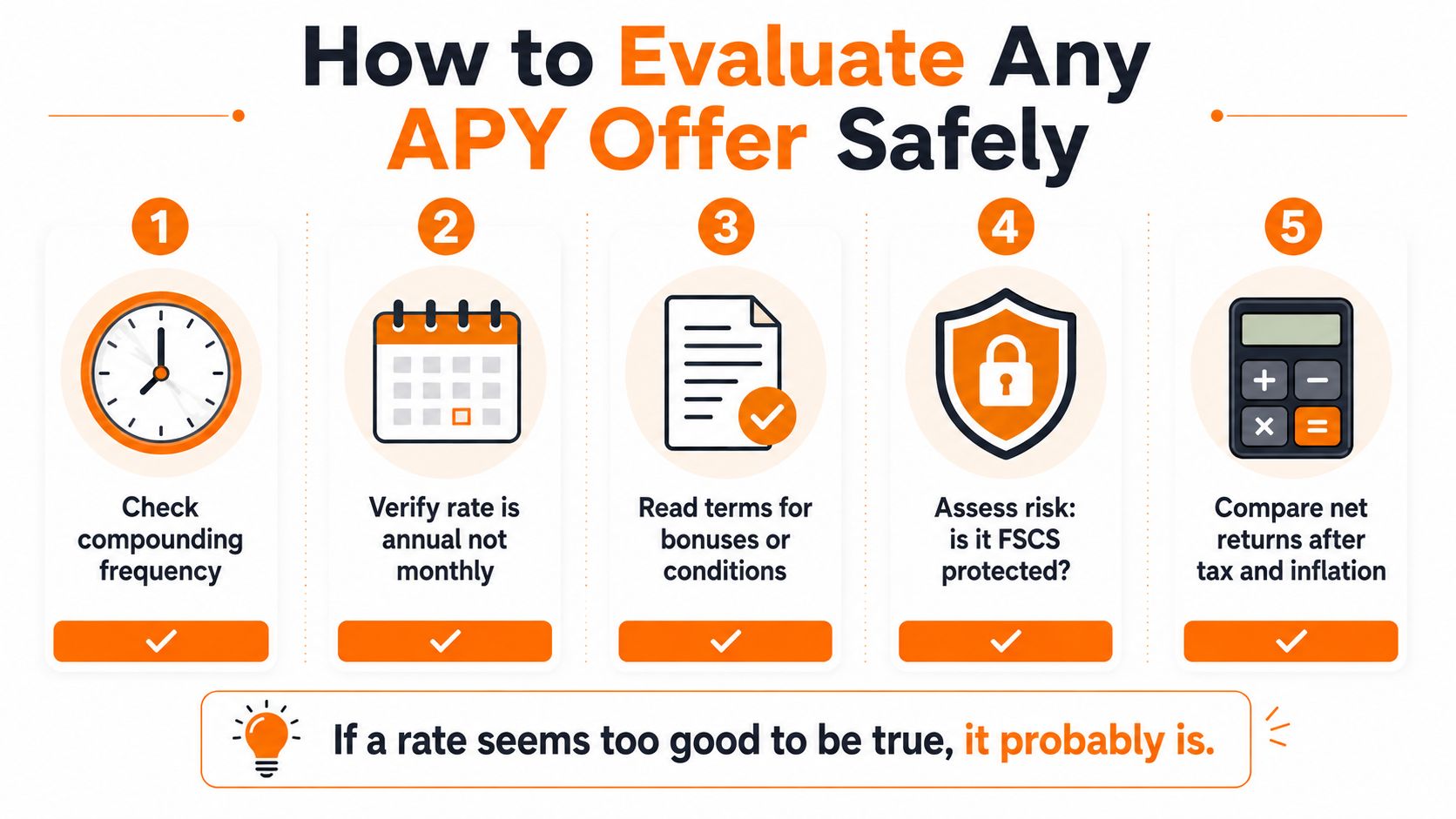
A strong APY offer should answer simple questions without making you chase the fine print. If the product is a bank account, the most important details are how often interest compounds, whether there are withdrawal limits, and whether there's any protection on the cash. If it's a crypto product, you also need to know how the reward is generated, who controls custody, and whether the token supply changes over time.
A quick checklist keeps you out of trouble
- Check the compounding frequency. A rate sounds better when it compounds more often, but the final APY depends on the actual schedule.
- Verify the rate is annual. Some promotions spotlight a monthly or limited-time number that looks bigger than it really is.
- Read the conditions. Bonus rates, minimum balances, and expiry dates can change the return fast.
- Assess protection. For bank products, ask whether your money is covered. For crypto, assume the risk profile is different until proven otherwise.
- Compare the net return. Tax and inflation can turn a decent-looking offer into a weak one.
The same caution applies when a rate looks unusually generous. If the platform won't explain how it generates yield, or if the return depends on complex token economics, treat that as a signal to slow down. A clear guide to evaluating new DeFi projects is available in how to research and evaluate new DeFi projects for beginners.
Best habit: Read the payout rules before you look at the headline number. That order saves a lot of mistakes.
Key Takeaways and Common Questions About APY
APY includes compounding, so it tells you more than a bare interest rate. Compare APY to APY, not APY to APR. UK tax allowances and inflation can shrink the real payoff, even when the headline looks strong. Crypto APY is not the same as bank yield, because the reward may be paid in volatile tokens and carry extra risks. A short checklist beats a shiny promotion when you're judging whether an offer is actually worth it.
Can APY change after you open an account? Yes, if the product terms allow the rate to move, or if a promotional period ends. How does APY work on tiered balances? Each band can earn differently, so the published APY may not reflect every pound in the same way. Does APY matter for a deposit held for less than a year? It still helps you compare offers, but the shorter the holding period, the more you should focus on the actual cash amount you expect to receive.
If you want more plain-English help like this, The Coin Course has beginner-friendly guides that break down crypto, DeFi, and risk in a way that's easy to use. Visit The Coin Course for more clear, practical education before you choose your next savings, staking, or yield product.