That gut-wrenching moment you realise your crypto is gone is something I wouldn't wish on anyone. But what you do in those first few critical hours can genuinely make or break your chances of recovery. The key is to shift from panic to a focused, methodical response.
Let's walk through what you need to do, step by step.
Your Crypto Theft Emergency Response Plan
That sinking feeling is real, but now is the time for a clear head. Think of it like digital first aid: you have to stop the bleeding before you can even think about healing the wound. A step-by-step approach is your best weapon against the chaos.
The absolute first priority is containment. Assume the device you were using when the theft happened—your phone, your laptop, whatever it was—is compromised. Get it offline. Unplug it, turn off the Wi-Fi, and do not use it to log into anything else.
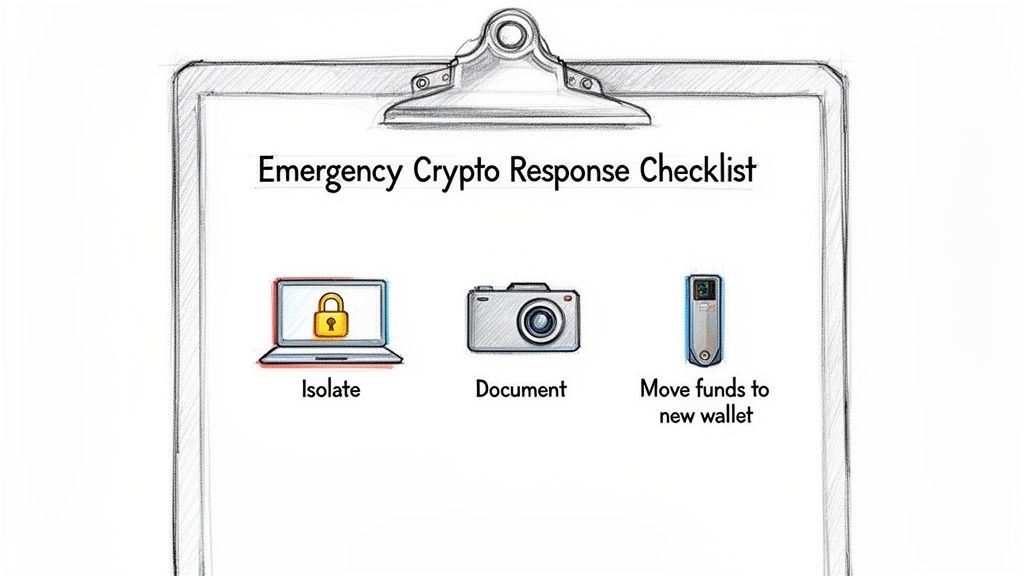
Isolate and Secure Your Remaining Assets
If you hold crypto in other wallets or on different exchanges, securing them is your next immediate move. Using a completely separate and trusted device, you need to transfer these funds to a brand new, secure wallet. This could be a freshly initialised hardware wallet or a new software wallet set up on a clean computer.
For example, say a scammer tricked you into entering the seed phrase for your MetaMask wallet after you clicked a dodgy link in a Discord message. You have to assume your entire laptop is now compromised. Grab a different computer—one you know is clean—create a new wallet, and immediately move any funds you have on exchanges like Coinbase or Kraken to this new, safe haven. Don't wait.
Document Everything Immediately
Once your other assets are safe, you need to switch gears and become a detective. Start collecting every shred of evidence you can find. This isn't just about jogging your memory later; you're building a case file that will be vital when you report the crime.
Here’s what to gather:
- Thief's Wallet Address: This is the most crucial piece of evidence. Copy the full address where your funds were sent.
- Transaction ID (TxID): Every transaction has a unique ID. Find it in your wallet's history—it's the digital receipt.
- Screenshots: Snap pictures of everything. The scam messages on Telegram, the phishing email that looked like it was from 'Coinbase Support', the fake website, and your wallet's transaction log showing the unauthorised transfer.
- Timestamps: Note the exact date and time the theft occurred. Be as precise as possible.
This process—secure, document, and then report—is the foundation of an effective response.
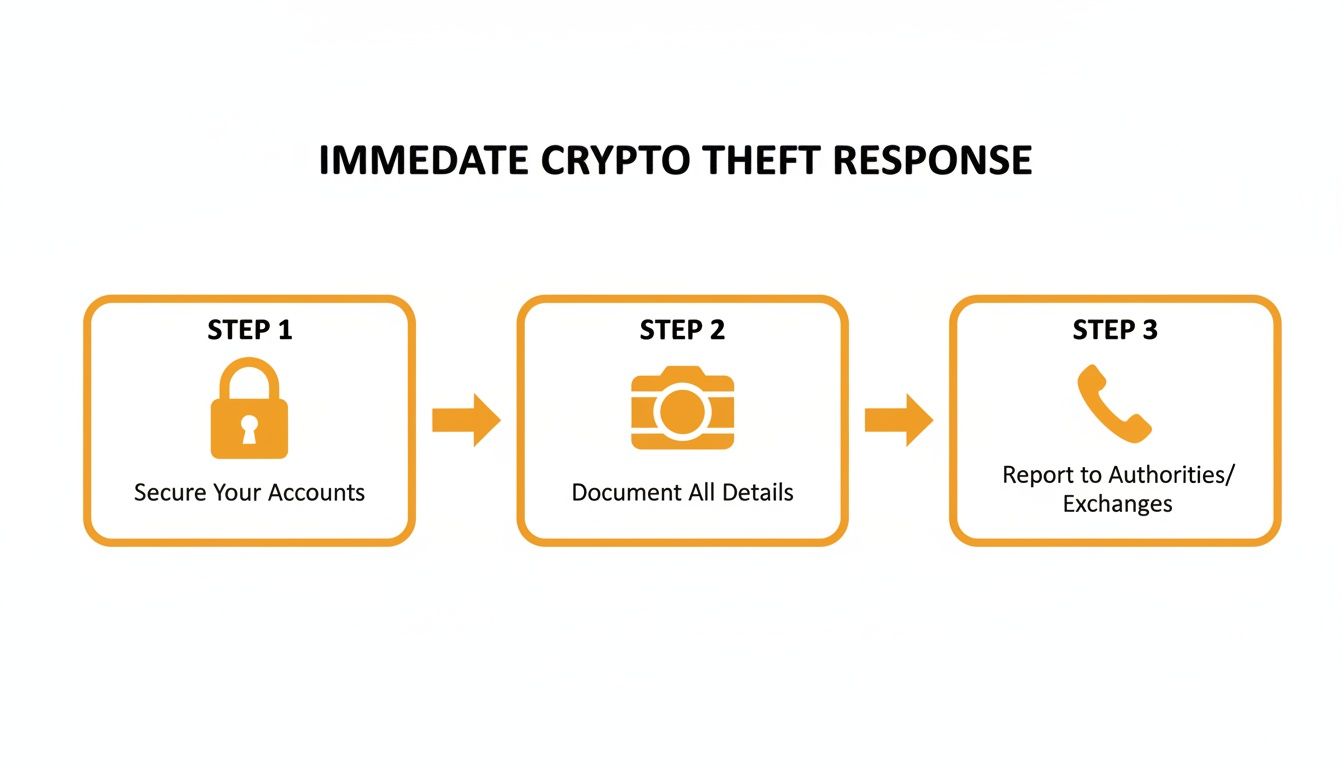
Having a clear visual plan like this helps reinforce that a structured approach is always better than a panicked one.
The table below serves as a quick-reference checklist. When you're under pressure, it's easy to forget a step, so keep this handy.
Crypto Theft Emergency Response Checklist
| Action | Contact or Platform | Why It Matters |
|---|---|---|
| Isolate Compromised Device | N/A - Physical Action | Prevents further unauthorised access or data leakage from the infected device. |
| Move Remaining Funds | Your other exchanges (e.g., Binance, Kraken) | Secures your other assets before the thief can potentially access them. |
| Report to Exchange/Wallet Provider | The platform where the theft occurred | They can freeze/flag the thief's account, making it harder for them to cash out. |
| File a Police Report | Your local law enforcement agency | Creates an official record of the crime, which is necessary for legal action. |
| Notify Financial Institutions | Your bank (if a card was linked) | Protects against fraudulent fiat transactions linked to your crypto accounts. |
| Change All Critical Passwords | Email, social media, banking, other exchanges | A compromised device could mean many of your accounts are at risk. |
Following these steps methodically ensures you're covering all the essential bases right from the start, giving you the best possible foundation for any recovery efforts that follow.
Report the Theft to Key Platforms
With your evidence organised, it’s time to start making calls. Contacting the crypto exchange or wallet provider involved is a critical step. While they can't reverse a transaction—no one can—they can often flag the thief's account or the destination wallet. This can make it much more difficult for the criminal to move or cash out the stolen funds.
If you’ve lost access to your accounts entirely, you might find our guide on how to regain access to your crypto wallet helpful for next steps.
Remember, the blockchain is permanent. Once a transaction is confirmed, it cannot be undone. Your goal in reporting is not reversal but to freeze the stolen funds downstream and provide critical data for law enforcement.
Tracing Your Stolen Funds on the Blockchain
Right, you’ve secured what’s left. Now it’s time to switch from defence to offence and start hunting for your stolen crypto. It might feel like it has vanished into the digital ether, but that’s rarely the case. The beauty of the blockchain is its transparency—it's a public ledger, meaning every transaction leaves a permanent trail. We just need to learn how to follow it.
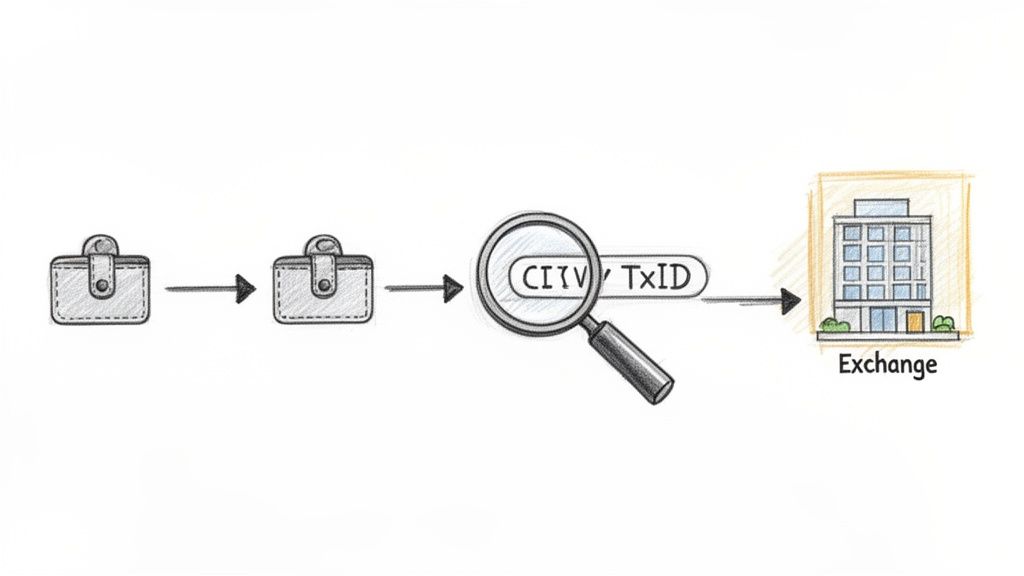
This process is called on-chain analysis. While it sounds complex, you can get started with the basics yourself using powerful, free tools known as block explorers. Think of them as the Google for blockchains.
Using Block Explorers to Follow the Money
Every major blockchain has its own explorer. For Bitcoin, a popular choice is Blockchain.com's explorer. For anything on the Ethereum network (ETH, USDT, SHIB, and thousands of others), Etherscan is the industry standard. Your golden ticket here is the Transaction Hash (TxID) you hopefully saved earlier.
Think of the TxID as your digital receipt or the tracking number for the theft. Pop that hash into the correct block explorer, and it will lay out the entire story of that single transaction.
You’ll immediately see crucial details:
- From: Your wallet address.
- To: The very first wallet the thief used.
- Amount: Exactly how much crypto was taken.
- Timestamp: The precise moment the transaction was confirmed.
This confirms the theft and, critically, gives you the thief’s wallet address. This is your first lead. The next step is to click on that "To" address right there in the explorer. This opens up a new page showing every single transaction that has ever moved in or out of that wallet. The hunt is on.
Your primary goal in tracing is to follow the money until it hits a wallet tied to a known entity, usually a major crypto exchange. This is the single most important breakthrough you can have, as exchanges are regulated businesses that can be compelled by law enforcement to take action.
If you want to get a better handle on the underlying tech, our guide explaining how does blockchain work is a great place to start.
A Real-World Tracing Scenario
Thieves aren't stupid. They rarely let stolen funds sit in the first wallet. They know people like you are watching, so they create a complex maze by moving the crypto through a series of different wallets to try and muddy the waters. This is where your persistence pays off.
Let's walk through a common example. A scammer has just swiped 1 ETH from you.
- The Initial Hit: You use your TxID to find the transaction. Your 1 ETH lands in Wallet A.
- The First Hop: You click into Wallet A and notice that a few hours later, the entire 1 ETH is sent to a new address, Wallet B. Often, they’ll mix it with funds from other victims at this stage.
- Splitting the Loot: From Wallet B, the thief gets clever and splits the funds. Maybe 0.4 ETH goes to Wallet C, and 0.6 ETH goes to Wallet D. Now you have two trails to follow.
- The Destination: After a few more "hops," you see that the 0.6 ETH from Wallet D was sent to an address that Etherscan has helpfully labelled as a "Binance Deposit" address.
Bingo. That’s a breakthrough. An exchange deposit is a massive clue because it means the thief is attempting to cash out or trade your stolen funds on a regulated platform. That exchange (Binance, in this case) is legally required to have "Know Your Customer" (KYC) details for that account holder. This is the hard evidence the police need.
Identifying Exchange Wallets
So, how can you spot when your funds have landed at an exchange? Block explorers do a lot of the heavy lifting, often labelling known corporate wallets. You might see public tags like "Coinbase," "Kraken Hot Wallet," or "Binance 14." These labels are a dead giveaway that the funds have moved from a private wallet into a centralised system.
Even without a clear label, if you find a wallet that receives thousands of small transactions from countless different sources, it's almost certainly an exchange's main deposit or holding wallet. While you can't be 100% certain on your own, it’s incredibly strong evidence to include in your report. Make sure you document every single wallet address and TxID along the chain. This detailed map is precisely what law enforcement and the exchange’s compliance team will ask for.
Working with Exchanges and Law Enforcement
So, you’ve done the on-chain detective work and mapped out where your stolen funds have gone. That’s a huge step. Now, it's time to hand that map over to the people who can actually set up roadblocks: cryptocurrency exchanges and law enforcement. Your groundwork provides the actionable intelligence they need to intervene.
This is the point where you shift from investigator to coordinator. The goal is to get the right information to the right people as quickly as humanly possible.
Your First Official Contact: Cryptocurrency Exchanges
If your tracing shows the stolen crypto has landed at a major exchange like Coinbase, Binance, or Kraken, you need to act immediately. Don't wait. These platforms are regulated businesses with compliance teams ready to handle illicit funds, but they can't do anything until you file a formal report.
When you reach out, keep it direct and professional. This isn't the moment for a long, emotional story; you need to provide clear, factual evidence.
Your report to the exchange must include:
- Transaction Hash (TxID): The specific transaction ID showing the funds moving into their platform.
- Thief's Deposit Address: The exact wallet address on their exchange that received your stolen crypto.
- A Clear Request: Explicitly ask them to freeze the funds in the destination account pending a law enforcement investigation.
For example, your message could be as simple as, "I am reporting the theft of 0.5 BTC. The funds were sent to one of your deposit addresses, [insert thief's address here], via transaction [insert TxID here]. Please freeze all assets associated with this account immediately."
Time is absolutely critical here. Thieves work fast, and they'll be trying to withdraw or swap those funds before anyone notices. You can get a sense of how quickly these situations unfold by reading about the critical Upbit unauthorized withdrawal and how assets were compromised.
Filing a Report with Action Fraud
Contacting the exchange is the first tactical move, but you also need to make it official with the authorities. In the UK, the only place to do this is Action Fraud, the national reporting centre for fraud and cybercrime. Filing a report here is non-negotiable if you want the authorities to get involved.
The Action Fraud online portal will walk you through the process, but go in prepared. You'll need to provide every piece of evidence you've gathered, including:
- Screenshots of any messages or interactions with the scammer.
- The transaction IDs (TxIDs) for the theft.
- All the thief's wallet addresses you’ve identified.
- Any associated websites, email addresses, or social media profiles.
A vague report like "my crypto was stolen" will almost certainly go nowhere. But a detailed file showing the exact path the money took gives investigators a solid starting point.
It's important to set realistic expectations. This process can be painfully slow, and recovery is never guaranteed. However, a police report with a crime reference number is often a prerequisite for an exchange to cooperate fully. You can't skip this step.
How Law Enforcement Can Make a Difference
It’s easy to feel hopeless and assume the police can’t do anything about crypto crime. While it’s certainly challenging, it's far from impossible, especially when they have good evidence to work with.
Look at the recent groundbreaking case from the UK's Metropolitan Police. They successfully recovered over 61,000 Bitcoin—valued at around £5 billion—tied to a massive investment fraud. This operation proved that even huge sums of laundered crypto can be traced and seized years after the crime. You can read more in the full report on the UK's economic crime strategy.
This kind of success story shows that with sharp tracing and swift police involvement, getting stolen assets back is a real possibility. When you file that report, you’re not just trying to solve your own case; you’re adding a crucial piece to a much larger puzzle, helping authorities build a picture of criminal networks that could lead to major enforcement actions down the road.
Hiring Professional Crypto Recovery Services
When the on-chain trail runs cold or the loss is truly devastating, it’s natural to feel like you’ve hit a dead end. This is the moment many victims start looking for professional help. But be warned: this corner of the crypto world is treacherous, populated by both genuine experts and predatory scammers.
Your first job is to understand the night-and-day difference between the two types of firms you’ll encounter. On one side, you have legitimate blockchain investigation firms. These are the real deal. They work alongside law enforcement and legal teams, meticulously tracing assets to build a concrete case. They deliver evidence, not empty promises.
Then you have the all-too-common recovery scams. These operations prey on desperation, often reaching out to victims on social media with fantastical claims of being able to "hack back" the funds or "reverse the transaction." If they ask for an upfront fee to do this, run. It's a massive red flag.
Spotting a Legitimate Service from a Scam
Learning to tell a real investigative partner from a scammer is absolutely crucial. These fraudsters thrive on the panic and urgency that follows a theft, making grand promises that are simply technically impossible on an unchangeable blockchain.
A legitimate firm will never, ever ask for an upfront payment to "unlock" or "release" your stolen funds. Their fees are for professional investigative services, just like hiring a private detective or a forensic accountant. They’ll be transparent about their methods and can usually point to a track record of collaboration with law firms and police forces.
The single biggest warning sign of a recovery scam is the promise to retrieve your crypto in exchange for an advance fee. Real investigators trace funds and provide evidence for legal action; they do not have a magic button to reverse transactions.
Think of it this way: a genuine firm sells you a detailed map and the evidence to prove where your stolen property ended up. A scammer tries to sell you a magic key that doesn't exist.
A Checklist for Vetting a Recovery Firm
Before you even think about engaging with a service, you need to do your homework. Treat this with the same seriousness as hiring any professional where a lot of money is on the line.
Use this checklist to help you sort the good from the bad:
- Physical Address and Registration: Can you find a verifiable corporate registration and a physical office address? A real business isn't hiding in the shadows.
- Professional History: Look for a paper trail. Have they been quoted by reputable news outlets, published their own investigative reports, or been listed as partners by established law firms?
- Team Credentials: Who are the people behind the website? You should be able to find investigators with backgrounds in law enforcement, cybersecurity, or financial crime analysis on platforms like LinkedIn.
- No Upfront Recovery Fees: This is worth repeating. They should charge for their time and expertise (like an hourly rate or a retainer), not a magical fee to "release" your stolen assets.
- Collaboration with Law Enforcement: Real firms know their work is meant to be used by the authorities. Ask them about their experience in preparing evidence packets for police reports and legal proceedings.
A genuine firm will welcome these questions and have ready answers. A scammer, on the other hand, will likely get evasive or try to pressure you into making a fast decision.
Exploring Legal Avenues in the UK
Hiring an investigator is often just the first piece of a much larger legal puzzle. In the UK, victims of significant crypto theft actually have some powerful legal tools at their disposal, but they all depend on having solid evidence from a tracing firm.
One of the most effective weapons in the legal arsenal is a civil freezing injunction, sometimes known as a Mareva injunction. This is a High Court order that can freeze assets worldwide, stopping a thief from moving or cashing out your stolen crypto. For example, if your traced funds are sitting in an account on Binance, a freezing order can legally compel the exchange to lock that account down.
Another powerful instrument is the Norwich Pharmacal Order (NPO). This court order forces an innocent third party—like a crypto exchange—to disclose information about a wrongdoer. So, if your funds were traced to a Kraken account, an NPO can require Kraken to hand over the verified identity (the KYC documents) of the person who owns it.
Make no mistake, these legal actions are expensive and complex, and you'll need specialised crypto litigation solicitors to navigate them. But for thefts involving large sums, they represent one of the most realistic paths to identifying the culprit and getting your assets back. There are now numerous case studies where victims, armed with strong on-chain evidence, have successfully used these orders to unmask anonymous thieves and reclaim their funds.
Securing Your Crypto to Prevent Future Thefts
Going through a crypto theft is a brutal, often expensive, lesson. The real takeaway isn't just about trying to get your funds back; it's about making absolutely certain you never have to face this nightmare again. Now is the time to tear down your old security habits and build a digital fortress around your assets.
This isn't about picking a slightly longer password. We're talking about a fundamental shift in how you store and handle your cryptocurrency. From this moment on, your goal is to become an incredibly difficult, time-consuming, and expensive target for any would-be thief.
The Gold Standard: Hardware Wallets
If you make only one change, let it be this: get your crypto off exchanges and software wallets and onto a hardware wallet. Think of a software wallet like MetaMask or a mobile app as the wallet in your back pocket—it's convenient, but it's also exposed. A hardware wallet, on the other hand, is your own personal bank vault.
These little physical devices from companies like Ledger or Trezor keep your private keys entirely offline. To authorise any transaction, you have to physically press a button on the device itself. That simple, physical step makes it practically impossible for a remote hacker to drain your accounts, even if your computer is riddled with malware. It is, without a doubt, the single most effective security upgrade you can make.
Upgrading to Multi-Signature Wallets
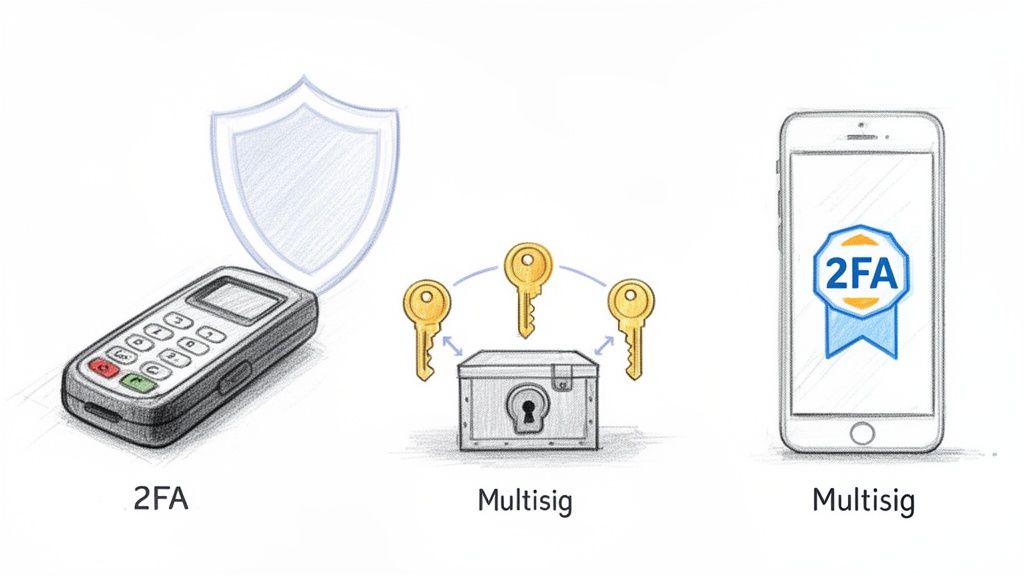
For anyone holding a significant amount of crypto, the next logical step up in security is a multi-signature (or 'multisig') wallet. The concept is a bit like a bank's safe deposit box that needs two different keys, held by two different people, to be opened.
A common and highly effective setup is a "2-of-3" wallet. This means you create a single wallet that has three private keys associated with it, but any two of them are required to sign and send a transaction.
- Key 1: Kept on your main computer.
- Key 2: Secured on your hardware wallet.
- Key 3: Stored in a completely different, safe physical location (like a safe or a bank deposit box).
With an arrangement like this, a thief would have to compromise two of your separate, independently secured devices to get at your funds. That's a monumentally harder task than just hacking a single phone or laptop.
Building Unbreakable Security Habits
Of course, the technology is only half the story. The other half is you. Thieves thrive on human error, which means tightening up your personal security practices is completely non-negotiable.
The most sophisticated security tools in the world can be undermined by one weak password or one accidental click on a phishing link. Your vigilance is an active part of your defence.
Start embedding these essential habits into your routine immediately:
- Unique, Strong Passwords for Everything: Stop reusing passwords. Right now. Get a trusted password manager to generate and store long, complex, unique passwords for every single exchange and crypto-related service you use.
- Mandatory Two-Factor Authentication (2FA): Switch on 2FA for every account that offers it. Crucially, use an authenticator app like Google Authenticator or, even better, a physical security key (like a Yubico key). Avoid SMS-based 2FA whenever possible, as it leaves you vulnerable to SIM-swap attacks.
- Master Phishing Detection: Get paranoid about spotting the red flags in suspicious emails and messages. Look for that manufactured sense of urgency, sloppy spelling mistakes, and sender addresses that are just slightly off. Always navigate to websites by typing the URL yourself instead of clicking a link in an email.
Even with rock-solid security, it's vital to remember that reporting financial crime helps protect the entire ecosystem. UK authorities are actively targeting fraud networks, with recent operations leading to numerous arrests and asset seizures. New rules for bank transfer scams also point to a growing framework for protecting victims, which is highly relevant since many crypto thefts start with a fraudulent bank payment.
When you report the crime to Action Fraud and your bank, you provide vital intelligence. This data helps exchanges and authorities spot criminal patterns and can improve the chances of freezing illicit funds. By fortifying your own defences and contributing to the wider intelligence picture, you help create a safer environment for everyone. You can read more about some of these UK anti-fraud initiatives and see how the landscape is changing.
Common Questions About Crypto Recovery
After the initial shock of a crypto theft, your mind is probably racing. It's a hugely stressful and confusing time, but getting clear answers to your biggest questions can help you focus on what to do next. Let's cut through the noise and tackle the most common concerns I hear from people trying to get their crypto back.
My goal here is to give you straightforward, no-nonsense answers so you can move forward with a bit more confidence.
Is It Actually Possible to Recover Stolen Crypto?
This is the first thing everyone asks, and the honest answer is: it’s incredibly difficult, but not impossible. Unlike a bank transfer, you can't just call someone up and reverse a blockchain transaction. Once it's confirmed on the chain, it's gone.
So, where's the glimmer of hope? Recovery becomes a real possibility when the stolen funds can be traced to a known entity, like a centralised exchange. We’ve seen successful cases, like when Thai authorities managed to recover $432,000 in USDT. These wins almost always come down to rapid-fire coordination between law enforcement, the exchanges involved (like Binance), and stablecoin issuers like Tether. They followed the money on-chain, and the second it landed somewhere identifiable, they moved to freeze it.
Recovery hinges on one critical factor: speed. The faster you can report the theft to exchanges and get a police report filed with solid on-chain evidence, the better your chances are of freezing those funds before they vanish into a mixer.
How Long Does the Recovery Process Take?
There's no set timeline, unfortunately. If you get unbelievably lucky and the thief is clumsy enough to deposit your funds straight into a cooperative exchange that freezes the account, you might see a resolution in a few months. But that's the best-case scenario.
For most people, especially when the case involves legal action and crosses international borders, you need to prepare for a long, drawn-out process.
- Initial Tracing: This can take anywhere from a few days to several weeks, depending on how complex the thief's trail is.
- Law Enforcement Reporting: Getting a crime reference number can be fairly quick. A proper investigation, however? You’re looking at months, sometimes years.
- Legal Proceedings: If you decide to go the civil route and pursue court orders, that can easily add another six months to a year (or more) to your wait.
Patience is key. The wheels of justice and international law enforcement turn slowly, but they do turn.
What Should I Do If I Can't Afford Legal Help?
This is a tough one, because legal action is prohibitively expensive for many. It's a frustrating reality. If hiring solicitors just isn't on the cards, your entire focus needs to shift towards building an ironclad case for law enforcement and the relevant exchanges yourself.
Your power lies in creating an undeniable evidence trail. Put together a meticulous report with every single transaction ID, wallet address, screenshot, and timestamp. Submit this to Action Fraud here in the UK, and send it directly to the compliance departments of any exchanges you’ve traced the funds to. While it’s not a court order, a detailed, evidence-packed report from a victim can absolutely trigger an internal investigation at an exchange and help authorities connect the dots on a larger criminal operation.
Can I Claim My Crypto Loss on My Taxes?
This gets complicated, especially here in the UK. In the past, you could sometimes deduct theft losses from your taxes, which offered a tiny bit of relief. However, recent changes in tax law have made this much harder for personal losses.
As a general rule, you can only claim a theft loss if it's connected to an investment or a business activity. For example, if you were tricked in a scam promising investment returns, you might have a case for a capital loss. But if funds were simply stolen from your personal wallet with no investment context, it's very unlikely you'll be able to claim it under the current rules.
My best advice? Always speak to a tax professional who specialises in digital assets. They can give you advice based on your exact situation.
At The Coin Course, we believe education is the ultimate line of defence. While recovering stolen assets is a tough battle, preventing the theft in the first place is entirely within your control. Our platform is dedicated to giving you the knowledge and hands-on skills to secure your crypto, spot threats early, and navigate the world of digital assets safely. Take a look at our expert articles and guides to build your security confidence today at https://thecoincourse.com.