You've launched the site, the product works, and a UK customer just asked whether they can trade through it. Then the awkward question lands in your inbox, do you need FCA sign-off, registration, or both? For a lot of crypto founders, that's the moment FCA compliance requirements stop feeling theoretical and start affecting marketing, product design, and even which customers you can serve.
The pressure is real because the FCA is not treating crypto as a side issue. Its 2024 work reviewed approximately 480,000 new websites that may have been operating without FCA permission, and that effort led to 19,766 promotions being withdrawn or amended, a 97.5% increase versus 2023 (Dentons summary of FCA enforcement trends). For crypto firms, that means the risk isn't just a slow application process, it's also a live promotions problem, a controls problem, and a governance problem.
If you're building for the UK, or marketing into it, you need more than a registration checklist. You need a working model of how the FCA thinks, what it expects to see, and how to prove your firm is still compliant after the launch day excitement has passed.
Why FCA Compliance Matters to Crypto Firms Today
A founder can get a platform live without thinking much about regulation, until the first UK user signs up and the questions multiply. Can the app show a referral bonus on Instagram? Can the custody flow hold client assets the way the product team wants? Does the token promotion need review before it goes out? Those are not edge cases anymore, they're routine FCA compliance requirements for crypto businesses that touch UK customers.
The FCA's posture toward crypto is part of a bigger regulatory shift. Its enforcement work has become more intensive, and the same 2024 review period also covered a regime change on 7 February 2024, when firms needed FCA permission to approve promotions for unregulated persons under the Section 21 Gateway (Dentons summary). For crypto firms, the FCA also reviewed compliance with the financial promotions regime introduced in October 2023 and finalised social-media guidance in March 2024 (Dentons summary). That's the key point, UK compliance now reaches well beyond a static website disclaimer.
What happens if you get it wrong
The practical consequences show up in different ways. Promotions get challenged, applications stall, and teams waste months fixing issues they could have designed out early. In serious cases, the firm can end up operating with the wrong permissions, which creates legal risk on top of commercial pain.
Practical rule: if a UK customer can see it, click it, or act on it, treat it as part of your compliance perimeter.
For crypto founders, the lesson is simple. The FCA isn't only checking whether you exist on a register, it's checking whether your firm can keep behaving properly in the everyday world. By the end of this guide, you'll have a plain-English map of what matters, what evidence the FCA tends to care about, and how to turn a compliance burden into a repeatable operating discipline.
What FCA Compliance Actually Means in the UK
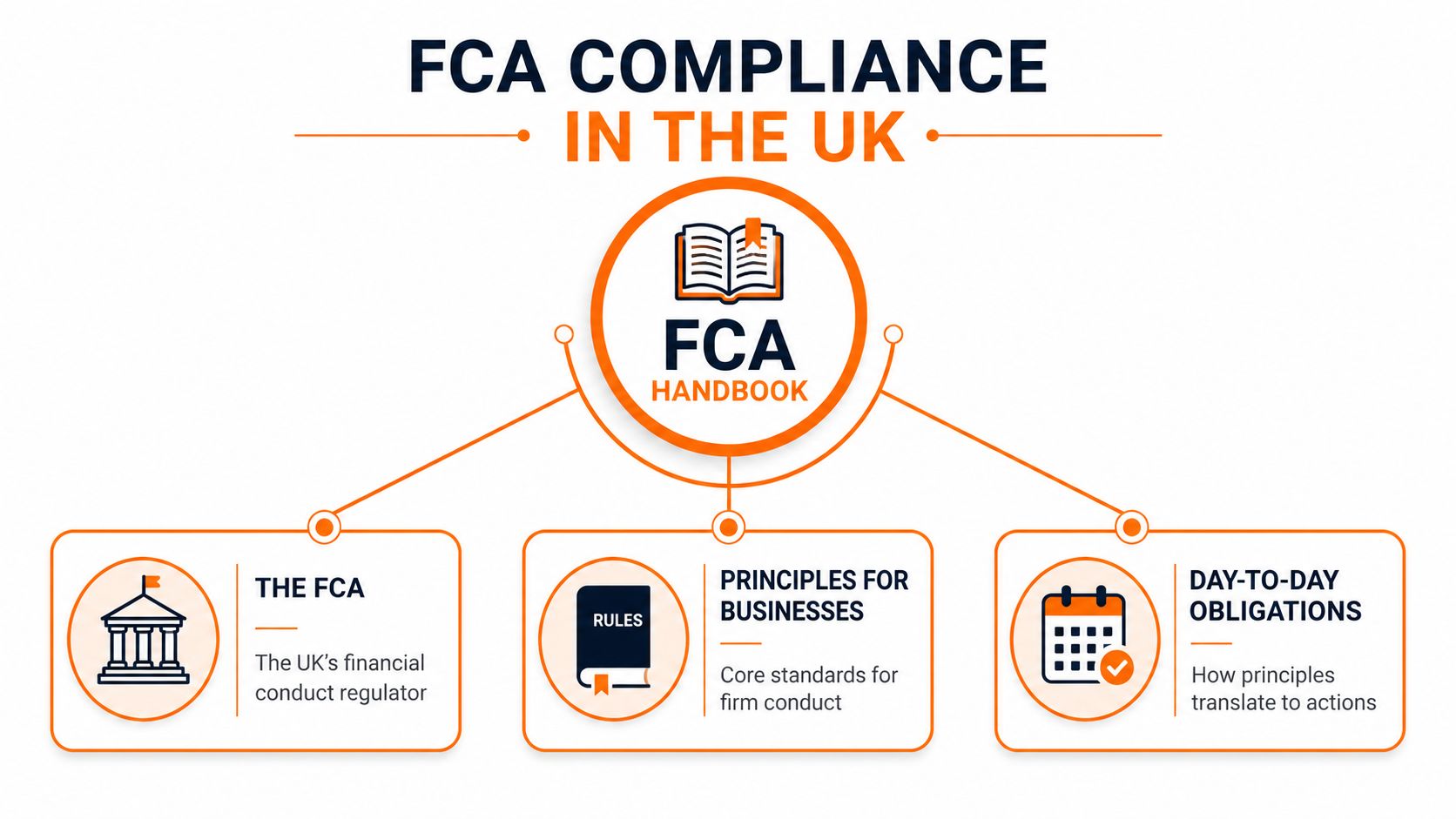
The FCA is the UK's financial conduct regulator. It was created after the 2008 global financial crisis as part of the UK's regulatory restructuring, with a core purpose of protecting consumers and maintaining market integrity (Atlan overview of the FCA Handbook). It was established on 1 April 2013, and one overview says it oversees about 42,000 businesses in the UK (LeapXpert overview). That scale matters, because this isn't a niche regulator watching a niche market, it's the main conduct regulator for a huge slice of UK financial services.
The practical home of compliance is the FCA Handbook. It sets out the rules firms must follow to operate legally, including conduct, systems and controls, reporting, and customer-treatment obligations (Atlan overview). The same source notes that oversight sits on top of the Principles for Businesses and the SM&CR Conduct Rules, which together shape how firms are expected to behave (LeapXpert overview). In plain English, the Handbook tells you how to behave, how to run the business, and how to prove you've done both.
Where crypto fits
Crypto faces a varied regulatory environment. Some activities fall under UK regulation, some are within a registration-only perimeter, and some remain unregulated. Exchange platforms, custodians, advisers, and token issuers do not all follow the same path, which is why a project cannot replicate another firm's compliance setup and expect it to be suitable.
A useful example is a custody service that holds client keys, a trading venue that matches buyers and sellers, and a token issuer that markets directly to the public. Those are very different activities, and the supervision questions change with them. A firm can't guess its category from the product pitch deck, it has to map the actual activity against the regime it falls into.
This UK crypto framework discussion is a useful reminder that licensing gaps still create real uncertainty for firms trying to build in public.
The simplest test is this. If your firm handles customer money, markets financial products, gives investment-like advice, or runs systems that affect customer outcomes, you're probably dealing with more than a basic website policy. FCA compliance is about making that activity defensible, not just documentable.
Registration and Authorisation for Crypto Firms
Crypto founders often use “registration” and “authorisation” as if they mean the same thing. They don't. A firm can be registered for cryptoasset business under the Money Laundering Regulations, or it can need full Part 4A authorisation if it carries on regulated financial services activity. The route depends on what the business does, not how the product team describes it.
The application journey usually starts with a brutally honest scope review. That means checking the legal entity, the services being offered, the customer types, and the way money, assets, or promotions flow through the platform. If the activity touches regulated territory, the FCA will want policies, governance papers, financial crime controls, and evidence that the firm can run the business safely, not just say it can.
What slows firms down
Many applications stall because the firm treats the submission as a form-filling exercise instead of an evidence pack. Gaps usually show up in ownership structure, outsourcing, transaction monitoring, and how the team handles complaints or customer harm. The FCA tends to ask follow-up questions when the story in the application doesn't match the actual product.
That's why experienced operators build the application like they're preparing for an audit, not a sales demo. If you want a broader compliance mindset from outside crypto, mastering compliance with Heights Consulting Group gives a useful sense of how regulated firms think about controls, ownership, and evidence.
The cleanest applications answer the same question three times, in the policy, in the diagram, and in the operational evidence.
For crypto teams comparing regimes, the licensing race in Europe has pushed many firms to rethink their route to market. The Coin Course's piece on Utorg obtaining a MiCA licence as the July 1 deadline forced much of the industry out of Europe is a useful reminder that regulatory timing can shape product strategy, not just legal paperwork.
The practical takeaway is simple. Registration gets you into one lane, authorisation gets you into another, and both require ongoing discipline. A firm that only prepares for approval, but not for supervision after approval, is only half-ready.
The Four Core Obligation Areas You Must Master
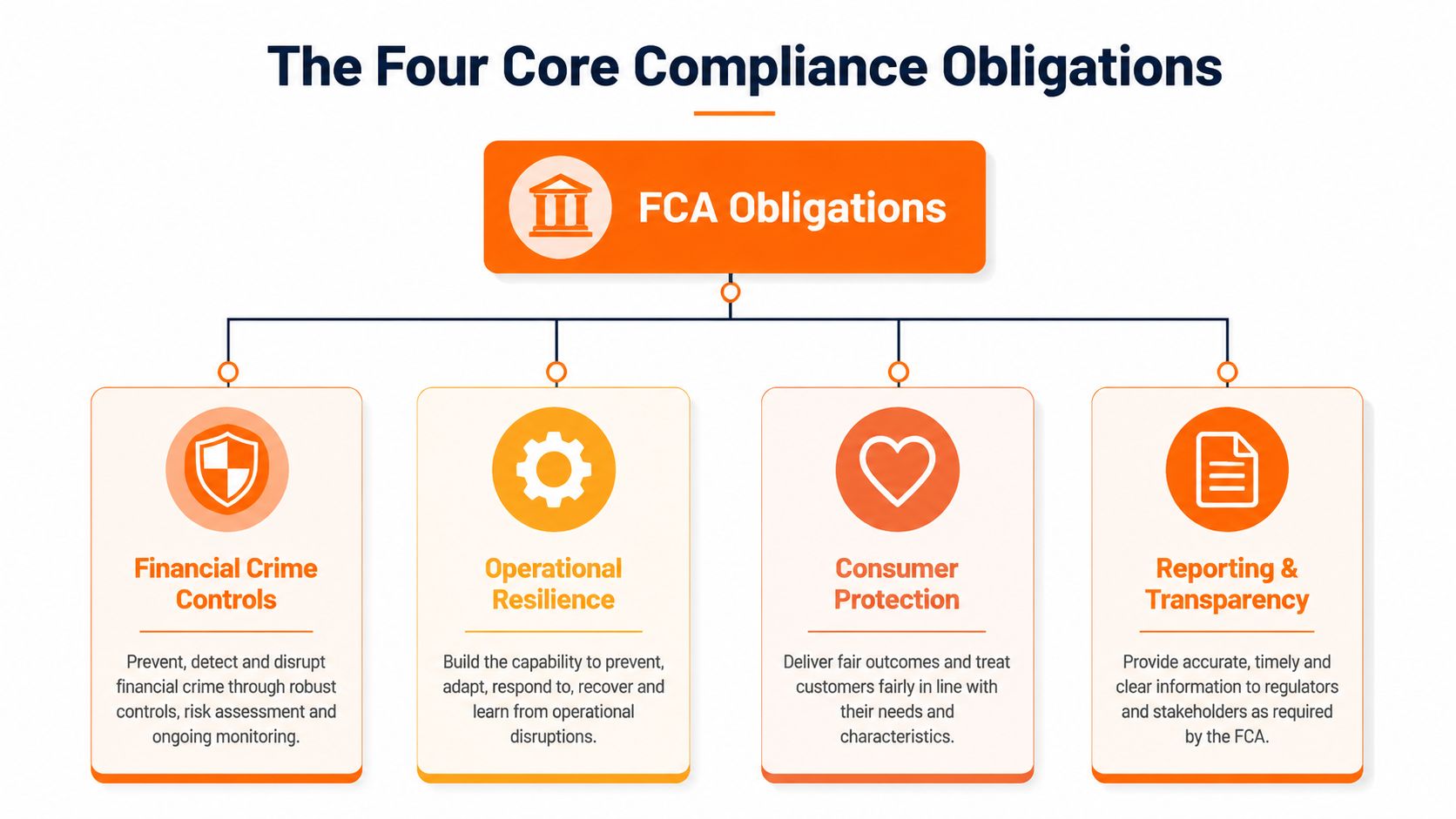
Once the firm is in scope, the daily work tends to cluster around four areas. The names vary a bit by business model, but the underlying burden usually falls into financial crime controls, consumer-facing controls, asset and data safeguards, and regulatory reporting. If your team can't point to an owner for each one, the compliance stack is probably too vague to survive scrutiny.
Financial crime controls
An exchange onboarding a customer under AML rules needs to know who it is dealing with, where the funds came from, and whether anything in the transaction pattern looks odd. That's not just a policy document, it's a live workflow between product, operations, and compliance. If the screening tool flags a wallet, someone must investigate and record what happened.
Financial promotions
A marketing team approving a social media advert has to think about financial promotions rules before the post goes live. The FCA's 2024 work on promotions and online marketing shows how hard it is to treat this as a side issue (Dentons summary). For a crypto firm, one careless influencer post can create a compliance headache far beyond the original campaign.
Custody and safeguards
A custodian segregating client assets needs clear controls around access, reconciliation, and error handling. The point isn't only theft prevention, it's proving that customer assets are treated as customer assets. In practice, that means the custody design has to be understandable to someone outside the engineering team.
Reporting and transparency
A compliance officer filing regulatory reports needs a clean data trail from operations into the report itself. That trail should show who checked the numbers, when they were checked, and what changed since the last cycle. Good reporting is less about paperwork and more about giving the FCA confidence that the firm knows its own business.
For UK payments and e-money firms, authentication is especially technical. Strong Customer Authentication rules require SCA when a payer accesses an online payment account, initiates an electronic payment transaction, or performs other remote actions with fraud risk, and dynamic linking binds the authentication to a specific amount and payee (UK Finance SCA guidance). The same guidance notes that the Transaction Risk Analysis exemption is conditional, so firms need monitoring, scoring, and auditability, not just a softer login flow (UK Finance SCA guidance).
Governance, Senior Managers and the Consumer Duty
Compliance gets much easier to understand when you ask who is personally responsible. Under the SM&CR, firms need senior managers whose responsibilities are clear, documented, and defensible. For a crypto platform, that usually means someone owns financial crime risk, someone owns technology and operational stability, and someone owns customer outcomes and conduct.
The board should not treat this as a naming exercise. A Statement of Responsibilities should map real decisions to real people, and the Responsibilities Map should show how those decisions connect across the firm. If a control fails, the FCA will want to know who was accountable for design, who monitored it, and who escalated the issue.
This security-token compliance guide is a helpful companion if your product sits near tokenisation, custody, or issuance.
How roles split in a crypto firm
A Chief Risk Officer can own the control framework, the escalations, and the challenge process. A CTO can own system resilience, logging, release controls, and technical evidence. The important bit is that the split has to make sense in practice, not just in the org chart.
The Consumer Duty raises the bar again, because boards need evidence that customers are getting good outcomes, not just that policies exist. The FCA also says firms must monitor customer outcomes, identify where groups are not getting good outcomes, adapt products and processes, ensure communications are understandable, and support customers in vulnerable circumstances across the whole lifecycle (FCA guidance on delivering vulnerable customers). That means a board pack should contain more than incident counts, it should show what customers experienced and what the firm changed.
For employee capability, training can't be treated as a one-off slide deck. The FCA's guidance on training and competence says firms must keep records for at least 3 years after the activity stops for non-MiFID business (FCA training and competence guidance). That matters because if a dispute lands later, you'll need evidence that the person was competent at the time and that the record survived long enough to prove it.
If you want a practical way to organise staff capability, build compliant employee programs with CloudOrbis is a useful reference point for turning policy into training that staff can absorb.
The best governance setups are boring in the right way. Everyone knows their lane, reports are regular, and the evidence trail is already there when the regulator asks.
Real-World Pitfalls and Lessons From Crypto Failures
Two fictional firms reached their first regulatory review with very different outcomes. The first, Northbank Token, had a basic but workable compliance stack. The second, Drift Exchange, had policies everywhere and evidence nowhere.
Northbank Token built monitoring into the product launch. Its compliance lead could show who reviewed transactions, how escalations were recorded, and how marketing sign-off worked. When the reviewer asked questions, the team answered with logs, versions, and board minutes. Nothing glamorous, just enough structure to make the story believable.
Drift Exchange looked polished on paper, but its controls were fragile. Marketing approved a crypto promotion without a clear sign-off trail, the transaction monitoring system produced alerts nobody reviewed consistently, and the team couldn't show that training records were retained for the required period. The review didn't fail because one thing went wrong. It failed because the firm couldn't prove it had control of the whole process.
The common mistakes
- Weak monitoring: alerts existed, but no one could show how they were prioritised or closed.
- Misclassified promotions: the marketing team treated a financial promotion like ordinary content.
- Missing competence records: staff were trained, but evidence vanished too early.
- Poor ownership: nobody could say which senior manager owned the issue end to end.
The lesson is not that regulators expect perfection. They expect a firm to know where the risk lives and to leave a paper trail, or a system trail, that matches the actual workflow. If the control only works when the original designer is in the room, it isn't a control.
For crypto founders, the pattern is clear. Good firms don't just pass one review, they build operating habits that make the next review less stressful. Bad firms try to reconstruct compliance after the fact, and that's always the expensive path.
Your 12-Month FCA Compliance Checklist for Crypto
The first year after submitting an FCA application should feel structured, not improvised. Month one is scope confirmation and governance design. Months two to four are policies, system build, and ownership sign-off. Mid-year is when testing starts, because controls that haven't been tried in a live environment usually fail at the worst possible time.
By month nine, the team should be able to run a complete evidence pack without scrambling. That means monitoring reports, complaint logs, training records, approvals, and escalation histories are all in one place. By month twelve, the firm should be thinking less about launch and more about routine monitoring, horizon scanning, and fixing weak spots before the next review.
| Compliance Task | When to Start | Estimated Internal Effort | Indicative External Cost |
|---|---|---|---|
| Scope review and permissions mapping | Month 1 | High | Medium |
| Policy drafting and approval | Month 1 to 3 | High | Medium |
| Monitoring and MI build | Month 2 to 5 | High | High |
| Staff training and competence records | Month 2 onward | Medium | Low to Medium |
| Vulnerability and complaints process testing | Month 4 to 8 | Medium | Medium |
| Board reporting and assurance cycle | Month 6 onward | Medium | Medium |
Keep the checklist short enough that the team uses it, and detailed enough that the FCA would recognise the work behind it.
A simple recurring list helps too. Review customer outcomes regularly, refresh the compliance plan every year, and watch for new FCA publications that change the way your controls need to work. If the firm can keep that rhythm, the first year stops being a fire drill and starts becoming a system.
Looking Ahead and Treating Compliance as a Product
FCA compliance requirements for crypto are tightening around evidence, not just policy. The regulator's direction is toward monitoring, resilience, and customer outcomes, which means firms need live controls, not dusty manuals. The smartest teams now treat compliance like a product feature, with an owner, metrics, and regular iteration.
That mindset matters because the best defence is usually not a clever legal argument, it's a clear operating system. If compliance is built into the product, the board sees it, the team uses it, and the firm can prove it when asked. For crypto firms in 2026 and beyond, that's the standard.